Sunday, 27 September 2015

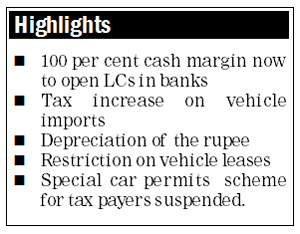
5-pronged strategy including tax hike to curb rising vehicle imports

By Bandula Sirimanna

Sri Lankan authorities, tackling an acute case of depleting foreign exchange reserves and a rising vehicle population, is resorting to a 5-pronged approach to cut imports and make vehicles costly to the population resulting in a likely 20 per cent cut in vehicle imports.

While a depreciating rupee in which the US dollar traded in the Rs.140-142 range this week from Rs. 134 flat a few weeks ago has made car imports costlier and restricted leasing facilities made it even more difficult to potential owners, an impending 100 percent cash margin for letters of credit (LCs), proposed hike in taxes and suspending car permits is seen plugging a hole in foreign exchange reserves.

The special facility of car permits given to taxpayers whose income tax liability in respect of any period of five years of assessment of not less than Rs. 250,000 a year has also been suspended to curb vehicle imports. Economists say the country’s total debt has skyrocketed to Rs. 8.2 trillion ($58.7 billion), almost half of which is foreign debt.

The government’s annual debt servicing costs have now surpassed total government revenue, aggravating the country’s balance of payments problems. The trade deficit has increased to US$4 billion during the first six months of the year, a 15.6 per cent increase compared to last year.

The Government is to also re-impose a 100 per cent margin deposit requirement against the LCs opened with the commercial banks for vehicle imports, official sources said. “Accordingly, LCs for the importation of vehicles cannot be opened in commercial banks without a minimum cash margin of 100 per cent and this will affect motor traders badly specially small scale dealers,” Ashok L. Ganwani, Director Lekhraj Automobiles (Pvt) Ltd told the Business Times.

Small players will be affected greatly as they have to pay upfront the value of the vehicle which is a huge burden to them, he said, adding that they are being already battered with the currency depreciation. The high import bill is the main concern of the Central Bank (CB) with declining currency other than fuel cost (though it is low in current market) and exceeding traffic congestion, he said.

Whatever policy issues to be brought up in the near future for the interest of national economy only is to be shouldered at the expense of the community, he pointed out.He noted that vehicle importers will have to block large amounts of their money for LC’s till the landing of vehicles.

Earlier they had the facility of opening the LC with a part payment and the balance could be settled after the arrival of the vehicle, he added. Tilak Gunasekara, Managing Director of Sathosa Motors Plc, said the new margin facility should apply only for cars, not for commercial vehicles and buses. He said transport and logistics sector is important for the Sri Lankan economy as it impacts on the country’s transportation of agricultural produce from the fields to retail shops.

On leasing facility constraints, the CB imposed limits on banks and finance companies in which loans and leases of vehicles should not excess 70 per cent of the value of the vehicle compared to 100 per cent earlier. This was welcomed by Rajiv Gunawardena, Chief Executive Officer, Asia Asset Finance Plc, who said the move would have a positive impact on the finance industry as well as on the overall economy.

He noted that it will mainly affect first-time buyers and those who are looking for their second vehicle. It should not have an impact on those replacing their vehicles. Leasing and hire purchase loans of motor vehicles have been one of the biggest product portfolios for the finance industry; therefore in terms of business activity there will be an immediate impact until the market adjusts for the change.

However this will help to improve the quality of the vehicle loan portfolio in the longer term, he pointed out. Abans Finance Plc Managing Director Kithsiri Wanigasekera was of the view that this move could restrain future credit growth of Sri Lankan leasing and finance companies and also reduce bad loans and defaulters.

He noted that most of the finance companies are not allowing 100 per cent vehicle leasing facilities, therefore its impact will not threaten the industry. www.sundaytimes.lk

Scrip issue from DCSL will be considered says Harry

The Distilleries Company of Sri Lanka PLC (DCSL), one of the country’s wealthiest conglomerates, will consider a bonus share issue, the company’s chairman, Mr. D.H.S. Jayawardena, said in response to a shareholder’s request at its annual general meeting last Monday.

The shareholder pointed out that DCSL carries very large reserves – Rs. 22.75 billion reserves and Rs. 37.95 billion retained earnings in its books as at March 31, 2015, and suggested a scrip issue.

Jayawardena responded the matter would be considered.

In response to another question on what the government owes the company on account of profits earned by the Insurance Corporation of Sri Lanka when DCSL was in control, Jayawardena did not give the figure of the sum owed but said that the "government auditor" was sitting on the matter and there had been no progress since "Mayadunne (a previous Auditor General C. Mayadunne) left."

The Supreme Court ordered that the Insurance Corporation which was sold to DCSL be taken back by government but profits earned during DCSL’s tenure be paid back to the company.

"With regard to the Sri Lanka Insurance Corporation Ltd. (SLIC), even after a lapse of six years, we still await the payment of profit earned during DCSL group’s tenure at the helm of SLIC," Jayawardena said in his chairman’s message in the company’s latest annual report.

"We are hopeful that the profit earned, which has to be paid back to us as per the Supreme Court directive, will be reimbursed to us as early as possible."
www.island.lk

Friday, 25 September 2015

Monetary Policy Review – September 2015 - Policy rates unchanged

Headline inflation, on a year-on-year basis, remained in the negative territory at -0.2 per cent for the second consecutive month in August 2015. Headline inflation, on an annual average basis, moderated further to 1.0 per cent in August 2015 from 1.3 per cent in the previous month. Meanwhile, core inflation increased to 3.9 per cent in August 2015 on a year-on-year basis, from 3.5 per cent in the previous month. However, annual average core inflation remained unchanged since June 2015 recording 2.8 per cent in August 2015. Going forward, headline inflation is expected to remain comfortably within 2.0-3.0 per cent by year end, supported by improved domestic supply conditions and subdued global commodity prices. 

In the monetary sector, broad money (M2b) recorded a year-on-year growth of 16.2 per cent in July 2015, driven entirely by the expansion in domestic credit aggregates. While credit granted to the private sector by commercial banks increased by 21.0 per cent, on a year-on-year basis, in absolute terms, credit granted to the private sector in July 2015 was Rs. 40.9 billion totaling to Rs. 245.9 billion during the first seven months of 2015. The increased credit flows to the private sector have been sustained mainly due to prevailing low market interest rates amidst low inflation environment. Meanwhile, the Central Bank has observed with concern the recent rapid growth of exposure of banks and financial institutions to certain categories of lending, in particular lending in respect of motor vehicles. Accordingly, with a view to preempt this trend which could develop into a system-wide risk to the financial sector, as a prudential measure, the Central Bank decided to impose a maximum Loan to Value (LTV) ratio of 70 per cent in respect of loans and advances granted for the purpose of purchase or utilisation of motor vehicles by banks and financial institutions supervised by the Central Bank. Going forward, the Central Bank will continue to be vigilant on the overall trends in the growth of credit as well as monetary aggregates and take pre emptive measures in the case of emerging risks threatening the maintenance of price stability on a sustainable basis. 

On the external front, the decline in expenditure on imports in July 2015 has been greater than the decline in earnings from exports, narrowing the deficit in the trade account of the month. With the Central Bank’s decision to allow greater flexibility in the determination of the exchange rate, so far in 2015, the rupee has depreciated by around 7 per cent against the US dollar. The recent depreciation of the exchange rate, which would enhance exports, while curtailing non essential imports, is expected to have a favourable impact on the trade balance. Such improvement, together with regular inflows of workers’ remittances and earnings from tourism along with other inflows to the services account would help narrow the deficit in the current account balance and strengthen the resilience of the external sector. Meanwhile, the gross official reserves, which stood at US dollars 6.8 billion at end July 2015, are estimated to have decreased to US dollars 6.4 billion by end August 2015. However, official reserves are expected to increase during the remainder of the year with the expected long term external financial flows to the government. 

According to the Department of Census and Statistics (DCS), the Sri Lankan economy is estimated to have grown by 6.7 per cent during the second quarter of 2015, recording a growth rate of 5.6 per cent for the first half of 2015 compared to 1.3 per cent recorded in the corresponding period of 2014. Economic growth during the second quarter has been largely supported by the improved performance in the Services sector along with positive contributions from the Industry and Agriculture sectors. 

Taking the above developments in the economy into consideration, the Monetary Board, at its meeting held on 25 September 2015, was of the view that the current monetary policy stance is appropriate. Accordingly, the Monetary Board decided to maintain the Standing Deposit Facility Rate (SDFR) and the Standing Lending Facility Rate (SLFR) of the Central Bank unchanged at 6.00 per cent and 7.50 per cent, respectively.


Sri Lankan stocks little changed ahead of policy rate decision

Reuters: Sri Lankan shares ended little changed on Friday ahead of the central bank's policy rate decision later in the day where it is widely expected to keep its policy rates unchanged.

The main stock index closed near its more than two-month closing low hit on Monday, down 0.06 percent at 7,110.80.

"There seems to be some investor confidence coming into the market. But investors are waiting to see the direction," said Dimantha Mathew, a research manager at First Capital Equities (Pvt) Ltd.

"Going into October, the market will be positive with confidence improving. The rupee is also seen settling gradually."

The monetary policy rate announcement is scheduled at 1230 GMT.

A weak rupee curbed investor risk appetite and rising market interest rates also hit sentiment, with t-bill yields at their highest level in more than five months at the last auction.

Turnover was 1.12 billion rupees ($7.95 million), its highest since Aug. 27 and in line with the daily average of 1.11 billion rupees. The turnover has been roughly half of this year's daily average since Aug. 31, stock exchange data showed.

Analysts said investors were waiting to see how the government would bridge the budget deficit and where the revenue would come from, in its November budget.

The IMF last week said the fiscal deficit is likely to range between 5.5 percent and 6 percent in 2015, much higher than an official target of 4.4 percent due to falling government revenues.

Foreign investors were net buyers of 317.4 million rupees worth of shares on Friday, but they have been net sellers of 2.49 billion rupees so far this year.

Shares of Ceylon Tobacco Company Plc fell 0.88 percent, while Peoples Leasing Plc dropped 3.49 percent. ($1 = 140.9500 Sri Lankan rupees) 

(Reporting by Ranga Sirilal and Shihar Aneez; Editing by Subhranshu Sahu)

Finance Houses and Leasing Companies to appeal to CB Relax vehicle leasing directive

By Ishara Gamage

Ceylon Finance Today: The Finance Houses Association of Sri Lanka and the Leasing Association of Sri Lanka have planned to request the Central Bank of Sri Lanka to relax its recently imposed vehicle loans and leases directive as it could restrict growth in their leasing and vehicle lending books, relevant Associations members told Ceylon FT yesterday.
"We are drafting separate letters to send the Governor of Central Bank by explaining our grievances and suggestions", they said. They believe that except vans and luxury vehicles all other vehicles could be omitted from this directive."Re-registered vehicles, two wheelers, three wheelers and commercial vehicles can be easily omitted from this directive; they have minimum effects for foreign currency outflows, an official of the Finance Houses Association," added. He also emphasized that limiting commercial vehicles such as agricultural vehicles, SME vehicles and buses could adversely affect the country's economic activities.

Leasing is the core business of the Sri Lanka's finance companies and it account for nearly 75% of its business. Leasing is represented around 5-10% of the banking sector business.
In an offer to scale down vehicle imports weighing on the country's Balance of Payment (BOP) the Central Bank sent directives to all banks and finance companies imposing restrictions on loans and leases to vehicles.According to the condition, all banks and finance companies are now only allowed to provide a lease of up to 70% of the vehicle value.The directive came into effect from midnight of September 14.Meanwhile, JB Securities releasing its August vehicle registration review said," Contrary to popular belief balance of payment crises that this country faces from time to time are not due to vehicle imports but due to a combination of monetary policy (not allowing a free floating exchange rate and/or not revising interest rates) and fiscal policy (public servant salary increases, not collecting enough taxes, under recovery of petroleum taxes, etc.). Thus the solution to the BOP crisis is to address the fundamental issues rather than meddle with vehicle taxes.

Brand new car registrations were 4,990 units in August lower than 5,773 units recorded in July but significantly higher than 788 units recorded 12 months ago. Small cars (<1,000 cc) accounted for 94% share of brand new registrations. Maruti's accounted for 4,075 units down from 5,024 units recorded in July but significantly higher than 380 units recorded 12 months ago. Maruti financing share was 61.2% lower than 68.4% recorded in July which may explain the slow down. Micro Panda accounted for 402 units up from 238 units in July.

Thursday, 24 September 2015

Investor: Future bright for Sri Lanka if policies are consistent, says intl hotel developer

Author CHAMATH ARIYADASA

(LBO) – With more stability in Sri Lanka, investors are keen to make long-term commitments, but their one ask is that policies are clear and remain consistent, Goulam Amarsy, an international hotel developer said.

Amarsy appreciated the potential of the island during his first visit to Sri Lanka in August. Now he is back, a month later, this time exploring investment opportunities and business tie ups.

“Future is great so long as there is clear and consistent policy,” Amarsy told Lanka Business Online.

Recent political developments after the August elections also points towards more stability, he said.

Amarsy has developed shopping centres, entertainment centres and hotels in North America and the Middle East, and is the managing director of Dubai-based Malchas Consultants.

His company has been involved in mixed-use real estate projects in the UAE, Pakistan, India and African countries, and facilitated retail deals on behalf of Carrefour, Landmark, CinePax and Virgin. In 2012, they entered into a joint venture with the Paris-based Warwick hotel group to manage hotels in the UAE and the Indian sub-continent.

Commenting on the international investment and financing environment, he said: “Investors in the Middle East are interested in making investments in Sri Lanka and the international financing environment is positive.”

“This is a new destination being rediscovered by international tourists. With everything it has to offer, we are convinced Sri Lanka will find its niche” he added.

Amarsy believes one of the standout strengths in Sri Lanka is the friendliness of the people which bodes well for tourism as a service industry, as it grows in stature as a major tourist destination.

Tourist arrivals increased 17 percent in the first eight months of this year to 1.1 million. The island is well on its way to 5 million tourist arrivals in the medium term, according to him.

Sri Lanka will benefit from increased tourists from the greater region and should target top income segments in the Indian sub continent, he added.

Good prospects seen for Sri Lanka home mortgage market

ECONOMYNEXT – Low interest rates in Sri Lanka have the potential to activate the home mortgage market into which a large pool of savings can be channelled, a senior analyst at a stock brokerage said.

In Sri Lanka housing finance is only about seven percent of total loanable assets with much of it backed by pension fund balances, said Murtaza Jafferjee, Managing Director of JB Securities.

In most countries the home mortgage market has a much higher share, he told an investment fund and asset management forum held by Fitch Ratings.

In the United States it is about 40 percent of total loanable assets and in countries like Thailand and the Philippines it is about 20 percent.

“So if you ask me where will this capital appetite really come from, this is the big one which has not taken off in sri lanka – that we don’t really have a mortgage market,” Jafferjee said.

Single digit interest rates would make it more likely the mortgage market would get activated, he said.

Sri Lanka has about five million households and an organised home building market can create a huge appetite for capital, he added.

“Everybody has a house but over 50 percent have a substandard house,” Jafferjee said. “That is where people like the funds can create bond funds. That has to activate. That is the big one to go. That is perhaps where most of these savings can go.”