Sunday, 8 November 2015

SL listed hotels’ profits low despite rise in tourists

By Duruthu Edirimuni Chandrasekera

Public quoted hotels of some major conglomerates witnessed low profits in the past quarter, despite tourist arrivals to Sri Lanka being up by 9 per cent last month, analysts say.For the quarter ended 30 September 2015, John Keells Holdings (JKH) leisure sector saw a 23 per cent drop over the same period in the last financial year to Rs. 885 million. “…. the decline is mainly on account of the partial closure of Cinnamon Lakeside,” JKH Chairman Susantha Ratnayake said in his statement.

In the Sri Lankan segment, many coastal properties of large hoteliers continued to witness pressure on ‘Average Annual Returns (ARRs)’ which came from the higher industry inventory.One of the main reasons for this drop in profits for large hotels is the changes in trends in hotel bookings and a shift towards the informal hotel sector, analysts say. Purasisi Jinadasa, Chief Strategist Capital Alliance says that many tourists prefer to stay in unclassified hotels. “Short term rentals, bed and breakfast lodging are becoming popular,” he said.

Meanwhile, there has been a gradual shift in the source markets for the country’s tourism sector, with arrivals from traditional markets of Western Europe declining as a percentage of total arrivals whilst East Asia and East Europe have increased its market share, led by China. Analysts say that these tourists command needs and wants different to their Western counterparts. Also online hotel booking has changed the game for many small hotels. Data showed that the growth of Internet booking services has made it easier for small scale lodging providers to sell rooms to a larger market. Popular hotel reservation engine – bookings.com, lists over 3,500 properties offering accommodation in Sri Lanka compared to around 300 graded establishments in the country.

A top hotelier said that with such a facility, travellers can select from a great catalog of hotels and finally choose what they actually want. “This beats having to go to your vacation destination on a limb and then to scour the place for a hotel you like and also within your budget,” he opined. Small hotels also offer budget deals and nowadays many tourists want to experience the destination. “So many won’t stay for long or care about a hotel. It’s just a clean bed, bath and wi-fi that they want,” the hotelier added.

A sector analyst noted that while occupancies in Cinnamon Grand and Cinnamon Lakeside are falling (the closure of the latter for refurbishment is also a factor) the group’s 3-star Cinnamon Red hotel’s occupancy is high. “This is because the Cinnamon Red prices correspond to the quality it offers,” he said, pointing out that most city hotels are overpriced. Hayleys, in its 2014/2015 Annual Report has said that the hotel sector is challenged due to increase of graded room supply as several new domestic and international players expanding capacity.

“The increased supply of graded hotel rooms has led to severe price competition and margin erosion, particularly given the prevalent shift in spending patterns of tourists,” it says.
www.sundaytimes.lk

“Progressive” tax on vehicles and luxury goods in 2016 Budget

By Bandula Sirimanna

Sri Lanka plans to unveil a “progressive” tax on vehicles, luxury and semi luxury goods, and imported food items in a bid to increase revenue and bridge the 2016 budget deficit.

The new tax rate on these luxury goods and vehicles is yet to be finalised, official sources said adding that it is likely to be around 5 per cent.

The 2016 Budget to be presented on November 20 is aimed at increasing tax to GDP ratio to a 14 to 15 per cent from 10.5 per cent at present.

VAT on vehicles at the import and selling point which was removed from the 2015 budget presented by the Rajapaksa regime and a new tax levied at the point of sale, will be re-introduced, a senior Treasury official said.

He said that the government is also considering the possibility of abolishing VAT on goods and services and bring it under the new “progressive tax” which will be levied on invoices.Motor traders said that the new policy will further increase the prices of vehicles and affect sales making it difficult for small motor dealers to survive.

Motor traders will recover the new tax money from buyers and the end result would be a vehicle price hike, Director of Lekhraj Automobiles (PVT) Ltd, Mahen L. Ganwani told the Business Times.He disclosed that small and medium scale importers of vehicles are under severe pressure with the new requirement of an annual licence fee of Rs.1.5 million introduced in the 2015 budget for brand new and used vehicle importers.

“This licence fee is unbearable for small and medium importers who cannot even pay heavy import duties at present.” he added.

VAT may be replaced by old BTT
The Ministry of Finance is considering replacing the Value Added Tax (VAT) with the old Business Turnover Tax (BTT) or Turnover Tax which was discontinued before 2000, sources said. 
“There’s a discussion going on currently on whether to replace VAT with BTT,” a Ministry source told the Business Times. The source said that the Ministry is concerned on issues pertaining to low revenue as many businesses evade VAT payments. “The revenue has dropped drastically over the years owing to VAT,” he said, adding that it was introduced to mitigate the cascading effect on domestic consumption goods and services.(Duruthu)
www.sundaytimes.lk 

Saturday, 7 November 2015

SL urged to improve investment climate with transparency and good governance

Dramatic hike in new vehicle registrations in 2015

By Hiran H.Senewiratne

Sri Lanka requires to improve the investment climate with transparency and good governance for businesses to flourish. If not the economy will suffer immense fiscal pressures, Carmudi Sri Lanka Managing Director Firaz Markar said.

"The wider macro-economic factors, such as steady GDP growth, access to low cost credit, and a rising level of affluence within major demographics of Sri Lankan society, have combined to generate an unprecedented level of growth within the Sri Lankan automotive industry in the recent past , Markar told a media conference in Colombo on Thursday.

Sri Lanka’s pioneering online vehicle retailer, Carmudi.lk, released a ground-breaking new research white paper detailing the recent performance of the Sri Lankan automotive industry and an in-depth analysis into key trends in vehicle financing.

Among the key findings of the Carmudi white paper was the dramatic increase in registrations of new vehicles in 2015, which hit an all-time high of 4,990 vehicles in August 2015, as compared with the previous year, Markar said.

He said small cars, hybrids and full-electric vehicles were found to have displayed a rapid increase in popularity among Sri Lankan consumers in 2015.

"This is boosted by the volatility in state regulatory and import policy, which may be having a notable impact on demand as consumers look to secure the best possible deal on their purchases, he said.
Analyzing historical data, the newly released Carmudi.lk white paper, titled ‘Car Financing in Sri Lanka’, offers valuable insights into the overall performance of the vehicle retail industry.

Markar said there is today a considerable amount of debate with regard to the current levels of demand for vehicles in Sri Lanka and regulations are needed to effectively cope with such demand in a manner that is beneficial to all stakeholders.

"In that context, the release of this report is a timely development that we hope will shed some light on the current dynamics in Sri Lanka’s automotive industry and hopefully contribute towards the formation of an effective discussion on regulatory policy and other salient issues that are informed by hard facts, he said.

Markar noted that potential changes to vehicle taxation policies and a reversal on downward interest rate momentum could tip the balance of vehicle financing in favour of an alternate model where consumers may be forced to take on a larger proportion of the total cost of the vehicle, potentially signalling a shift in conditions for finance companies and banks.

"Recent events resulting in vehicle values going up have definitely affected the market. 

We see lower sales in vehicles since news broke of this increase. Interest rate changes are not expected to affect the market drastically due to it being a very nominal increase thus far.

"We will continue to monitor the market over the next month or so as dealers adopt a wait and see approach towards vehicle buyer intent, Markar added.
www.island.lk

Nestlé Lanka announces ‘stable growth’ of 8.6% for Jan - Sept 2015

Nestlé Lanka PLC, a leading Nutrition, Health and Wellness Company in Sri Lanka, posted revenue of LKR 27.1 billion for the nine months period ending 30 September 2015 recording a growth of 8.6% vs previous year. The company reported a net profit of LKR 3.5 billion, a growth of 9.8% for the same period.

For Q3 2015, the company delivered revenue of LKR 8.8 billion and net profit of LKR 1.0 billion, indicating steady performance and enhanced investment behind its brands.

The third quarter of the year saw Nestlé Lanka reaffirm its position as a leading company in Sri Lanka, and was ranked amongst the top 15 business entities in Sri Lanka by the ‘Business Today TOP 25’, based on its financial performance during 2014-2015.

"The steady performance delivered by our company in the first 9 months of 2015, is a result of the trust our consumers repose on the quality and safety of our products. We once again reaffirmed our position as a leading and respected company, committed to enhancing the quality of life of the people of Sri Lanka, through our strong brands and rural development initiatives," said Shivani Hegde, Managing Director of Nestlé Lanka PLC.

As a leading Nutrition, Health and Wellness provider, Nestlé Lanka continued its focus on encouraging physical activity and an active lifestyle, and offering specialized milk-based nutrition for different stages of life. Products like Milo ready to drink, Nestomalt malted food drink, Nespray growing up milks, and the recently launched Nespray Nutri Up ready to drink, promote the goodness of locally procured Sri Lankan milk fortified with nutrients like Iron and Vitamins, leveraging Nestlé’s global expertise in nutrition. This was supported with the company’s continued commitment towards developing the Dairy Industry, as the largest private sector collector of local fresh milk in Sri Lanka.

The company also rolled out a large multi-brand wellness initiative, ‘Choose Wellness Choose Nestlé’, offering consumers a range of wellness solutions to promote a healthy and balanced lifestyle. The campaign also incorporates the Nestlé ‘Choose Wellness’ van that is travelling island-wide, providing free nutrition counselling and health checks to consumers. (Nestlé Lanka)
www.island.lk

Friday, 6 November 2015

Sri Lanka shares gain; econ policy statement boosts sentiment

Reuters: Sri Lankan stocks rose to their highest in more than a week on Friday as the prime minister's medium-term economic policy statement, which focused on raising revenue through reforms and suspending retrospective taxes, helped boost sentiment.

The main stock index ended 0.6 percent higher at 7,059.48, its highest close since Oct. 29.

The day's turnover stood at 1.75 billion rupees ($12.41 million), much higher than this year's daily average of 1.1 billion rupees.

"Everybody reacted very positively to the prime minister's statement. This gives an indication that the budget will be very favourable," said Reshan Kurukulasuriya, chief operating officer of Richard Pieris Securities (Pvt) Ltd.

Prime Minister Wickremesinghe, outlining the country's economic priorities ahead of the 2016 budget, said the government would minimise tax holidays and aim to garner more revenues from the rich through direct taxes.

The prime minister's announcement that a proposal to impose a retrospective tax targeting corporates would be annulled helped boost investor confidence, analysts said.

In September, parliament approved finance bills to raise 80 billion rupees in revenues, including from a super gains tax to be paid by corporates that earned more than 2 billion rupees in the last financial year.

Analysts said the next trigger for the markets would be the budget, scheduled for Nov. 20.

Shares in conglomerate John Keells Holdings Plc gained 2.48 percent while Sri Lanka Telecom Plc rose 3.20 percent and Nestle Lanka Plc rose 2.44 percent.

Foreign investors, who have been net sellers of 3.71 billion rupees worth of equities so far this year, bought a net 16.5 million rupees worth shares on Friday. 

($1 = 141.0000 Sri Lankan rupees) 

(Reporting by Ranga Sirilal and Shihar Aneez; Editing by Sunil Nair)

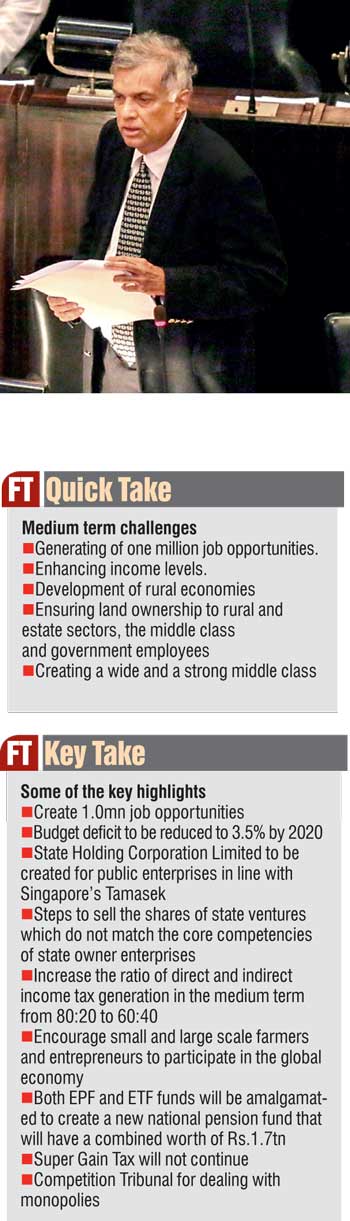
Ranil for real growth, reforms

  • Prime Minister makes revolutionary and comprehensive economic policy statement to ensure meaningful and sustainable development 
  • Announces far reaching economic and social reforms to generate crucial employment and rise in incomes to people 
  • Moots fundamental economic policy changes and restructuring in public sector including privatisation via credible stock market 
  • Commits to prudent fiscal management with record low Budget deficit 
  • Assures support for socially responsible private sector led growth 
  • Highlights future high growth sectors with special emphasis on exports, local industries 
  • Minimise tax holidays, want foreign and local investors to benefit from be competitive via peace dividend and other benefits 
  • PM’s statement widely commended but analysts insist it requires strong leadership, political stability and a competent team to deliver

By Ashwin Hemmathagama,  Our Lobby Correspondent

Prime Minister Ranil Wickremesinghe yesterday spelled out his economic policy priorities, as he unveiled the Government’s socio-economic program to make Sri Lanka a vibrant and successful global citizen. 


The much awaited, comprehensive outline of future direction of the country was made in Parliament by the Premier in his Economic Policy Statement ahead of the unity Government’s maiden Budget for next year on 20th November.


The speech which received widespread applause within Parliament signalled that the Sirisena-Wickremesinghe unity Government means business or wants to get down to business post-Budget. This position of strength comes from the overwhelming mandate received on 8 January and reinforced on 17 August and after having restored Sri Lanka’s image internationally especially with regard to sincerity and commitment on post-war reconciliation.

The visionary economic policy statement found favour with a majority of MPs and those who believe Sri Lanka can get its economic policy right going forward. Initial response from the private sector and other stakeholders was one of confidence and hope. However such a bold vision would require strong leadership, political stability and a competent team to deliver, which most analysts confirm will be the key challenge.

Having succinctly recapped historic and recent ills of the country and political and economic policies, Premier Wickremesinghe’s presentation focused largely on the way forward, a journey he said would require revolutionary thinking, bold policies and initiatives to transform into a vibrant and prosperous nation.


“From 8 January onwards, we have been able to lift the people of this country up from their economic woes,” said Premier Wickremesinghe.

“The boasts of the previous Government about the increase in individual income levels was simply not true. Let us learn the lessons from the past. We will celebrate 75 years of independence in the year 2023. If we walk the right path, we have the potential to become one of the strongest economies of Asia. So let us seize the opportunity – let us rise higher towards our goal,” said Wickremesinghe.


“I would like to point out that all signs that assure us we are on the right track are here,” he said after listing a series of policy measures.

Wickremesinghe said that the economy that the unity Government plans to build must yield results for all. “An economy that will promote the benefits of development among all. An economy that will be friendly to all, beneficial to all. An economy that will pave the way for sustainable development,” he said.

“What we are hoping for is a lawful economic environment that will set the stage for sustainable development. We will incorporate a sustainable development entity that will provide the necessary framework and initiate the needed mechanisms,” said the Premier.

“The third generation of economic reforms envisioned by us as indicated here, is based on multifaceted economic mechanisms and the increase in trade development. Many qualified people prefer well-paying jobs that are given based on professional capabilities. 

It is not viable to maintain a low paying production based economy,” he added.
In summing up the Prime Minister said “We need to make sure the golden era of prosperity that Sri Lanka had during the period from Manawamma to Maha Parakramabahu dawns again. We must enter the right path for this to happen, with accountability, patience and commitment. Only then can we create a better country for our future generations and lift our country to the rightful place it deserves.”


“This is why we need to make use of this opportunity. It is a collective responsibility for us all. I invite all of you to join hands with us and bear responsibility in making this vision a reality.”

Sri Lanka under global spotlight
Prime Minister Ranil Wickremesinghe yesterday suggested that Sri Lanka will increasingly come under positive global spotlight.
“We have been invited to participate in the world famous World Economic Forum due to be held in Davos Switzerland in January 2016 with the participation of over 40 heads of state and 2500 economists. Before that, we will have an economic summit in Sri Lanka – the highlight of this will be participation of world famous author and investor George Soros,” said the Premier.
“Additionally, the world famous Euromoney magazine will sponsor an economic summit in Sri Lanka in January 2016. All these activities will give Sri Lanka the opportunity to connect our economy with the world,” he added.

Market welcomes PM’s statement

Lanka Securities said yesterday that the Colombo bourse welcomed the economic policy direction set by the Premier Wickramasinghe and closed in the positive territory on Thursday. “Prime minister’s speech which was delivered near to the session close managed to lift the index from the 7,000 mark to close the day at 7,017.39 with a gain of 13.82 index points or 0.20%. S&P SL20 index bagged 9.50 index points (+0.25%) to end at 3,794.11,” it said.
“Though the investor reactions to policy speech can only be seen in full in the next session, it is expected that the positive policy reforms introduced to address economic issues would be well-received by the investors,” Lanka Securities added.
SC Securities said “Colombo equities demonstrated an upward trend today, with the announcement of basic economic reforms by the Prime Minister, in the parliament.”
Reuters said stocks ended firmer on Thursday led by blue chips, and stockbrokers expect the market to react positively to the Prime Minister’s medium-term economic policy statement, which focused on raising revenue through reforms.
The main stock index ended 0.2% higher at 7,017.39.
The day’s turnover was Rs. 779.8 million ($5.51 million), less than the year’s daily average of Rs. 1.1 billion.
Prime Minister Wickremesinghe, outlining the Government’s economic priorities ahead of the 2016 Budget announcement, said the Government would minimise tax holidays and aim to garner more revenues from the rich through direct taxes, a move that could be praised by the International Monetary Fund.
“All in all, it looks positive. This is what people have been waiting for,” said Dimantha Mathew, a research manager at First Capital Equities Ltd., adding that he expected the market to react positively to the Prime Minister’s statement.
The next trigger for the markets would be the budget scheduled for 20 November, analysts said.
Shares in Hemas Holdings Plc rose 3.13% while conglomerate John Keells Holdings Plc gained 1.40%.
Foreign investors, who have been net sellers of Rs. 3.71 billion worth of equities so far this year, bought a net Rs. 16.5 million worth shares on Thursday.www.ft.lk

HNB raises US$ 50 m from Proparco

HNB PLC entered into an agreement with Proparco to raise US$ 50 m through a five year senior long term loan.

This is the third debt raising exercise completed by HNB this year from international funding institutions increasing the total amount raised from foreign sources to US$ 185mn.

At the signing ceremony held in Colombo HNB CEO Jonathan Alles said the willingness exhibited by institutions of the stature of Proparco to partner with HNB provides testimony to HNB's financial strength and stability and serves as an endorsement of our robust risk management and governance frameworks.

He said the funds raised will be utilized to fund SME and agriculture businesses.

"HNB since its inception has been serving the SME sector and has been a key enabler in driving the growth in this segment. This transaction will further strengthen our market position in SME lending while contributing to boost economic growth,"he said.

Proparco's Chief Investment Officer Amaury Mulliez said Proparco is contributing to strengthening a player that finances two key economic sectors in Sri Lanka. Proparco is the private sector financing arm of Agence Francaise de Development (AFD) and has been working to support world development initiatives for over 40 years.

Proparco plays a key role in financing and supporting projects lead by companies and financial institutions in developing and emerging countries focusing mainly on infrastructure, renewable energies, agriculture, finance, health and education sectors.
www.dailynews.lk