Thursday, 22 December 2016

Sri Lankan shares fall for 8th straight session in thin trade

Reuters: Sri Lankan shares fell for an eighth straight session on Thursday, closing at their lowest in more than eight months, in typical holiday-thinned trade as investors stayed away ahead of the Christmas weekend.

The Colombo stock index ended 0.28 percent weaker at 6,209.65, its lowest close since April 6. The bourse has fallen 2 percent in the last eight straight sessions through Thursday.

Turnover slumped to a near four-week low of 114.5 million rupees (about $764,608), less than a sixth of this year's daily average of 740.6 million rupees.

"A lot of people are out of office because of holiday season. Foreign trading is also very slow because of the year-end holidays in other markets as well. We see the same sentiment prevailing until the new year," said Hussain Gany, deputy CEO at Softlogic Stockbrokers.

Foreign investors bought a net 25.3 million rupees worth of shares on Thursday, extending the year-to-date net foreign inflow to 625.7 million rupees into equities.

Banking and telecommunications sectors saw market activity, with trading in top mobile phone operator Dialog Axiata accounting for 24 percent of the day's turnover.

Shares in large cap Ceylon Tobacco Company lost 2.4 percent in lacklustre trade, while top private lender Commercial Bank of Ceylon fell 1.2 percent to drag down the overall index.

($1 = 149.7500 Sri Lankan rupees) 

(Reporting by Shihar Aneez; Editing by Biju Dwarakanath)

Colombo Stock Exchange Market Review – 22nd Dec 2016


Colombo bourse stretched losing streak for the eight straight days in another lackluster trading session. All Share index lost 17.68 index points or 0.28% during the session to close at 6,209.65 while high cap constituent, S&P SL 20 index dipped by 12.20 index points or 0.35% to end at 3,478.15.

High caps namely, Ceylon Tobacco (closed at LKR 819.90, -2.4%), Commercial Bank (closed at LKR 141.30, -1.2%) and Lanka Orix Leasing (closed at LKR 73.00, -2.0%) drove the index down.

Daily market turnover was LKR 115mn with absence of negotiated transactions. Dialog Axiata emerged as the top contributor to the turnover with LKR 27mn followed by Cargills (LKR 9mn), Chevron Lubricants (LKR 8mn) and Hatton National Bank non-voting (LKR 8mn).

Market breadth was negative where out of 186 stocks traded, 67 slipped, 35 advanced. High investor activity was witnessed in Lanka IOC, John Keells Holdings and Chevron Lubricants.

Brac Lanka Finance intends to raise LKR 1.3bn via rights issue of shares in proportion of 05 new ordinary shares for every 04 ordinary shares held, in order to comply with the minimum capital requirements.

Foreign investors were net buyers with a net foreign inflow of LKR 25mn. Foreign participation was 21%. Net foreign inflows were seen in Dialog Axiata (LKR 27mn), Hatton National Bank non-voting (LKR 7mn), Union Bank (LKR 1mn) while net foreign outflow was mainly seen in Chevron Lubricants (LKR 7mn).

Meanwhile, rupee against dollar reached its highest value in history of LKR 152.12. During the year, rupee depreciated 4.1% against the last year depreciation of 9.6% (CY2015).
Source: LSL

Wednesday, 21 December 2016

Sri Lanka's Pan Asia Bank raises over $17 mn with Symbiotics Group

Pan Asia Bank recently entered into an agreement with the Symbiotics Group, a Geneva based fund specialising in providing credit facilities for SME development worldwide, to raise over US$ 17 million through a senior debt arrangement.

Under the agreement with Symbiotics, the funds will be made available in two components, one in US$ and the other one in Lankan Rupees.

Symbiotics is a leading global investment company dedicated to inclusive and sustainable finance in emerging and frontier markets. This fund which has invested over $2.8 bn across over 60 countries is mainly engaged in Asset Management, Investment Advisory, Investment Analysis, Capacity Building and Technical Assistance Research.

Each investment made by Symbiotics is filtered through a social responsibility rating, alongside traditional financial evaluations, adopting a multi stakeholder approach (ESG norms), balancing the multiple interests at stake along the value chain in order to maximize their long term sustainability and value creation.

Hence securing this loan is a clear indication of how Pan Asia Bank’s multi faceted growth was recognized by the loan provider in qualifying the bank in terms of each of the above criteria.

Further, granting of this credit facility is also a strong indicator of the confidence and trust the reputed global investment fund players place in Pan Asia Bank and its growth momentum, especially given the attractive rate at which this loan has been offered.

Securing of this credit facility comes at a time when Pan Asia Bank is in the process of enhancing its capital base through an already announced rights issue which is expected to further bolster the bank’s balance sheet.

TSW Capital Services (TCSPL) based in India provided the advisory services to the Pan Asia Bank and Sybiotics Group to complete the funding arrangements.
www.dailynews.lk

Rs. 15 b Govt. revenue up in smoke in 4Q after excessive taxation on tobacco

The recent unprecedented spike in taxation on tobacco is estimated to have caused a near Rs. 15 billion loss in revenue for the Government in the fourth quarter of this year and a staggering Rs. 25 billion in 2017, according to industry analysts.

They said that the revenue loss was due to the sale of cigarettes plunging by almost 50% in recent months after the Government drastically raised prices.

Due to the upward revision in Excise and 15% VAT, the prices of cigarettes increased by 82% for the low-end brand Capstan and 36% for Bristol. The premium yet fastest growing brand Dunhill saw its price shooting up by 45% and popular brand Gold Leaf by 43%.

Resultantly, monthly cigarette sales have dropped to 150 million sticks in October and November as against a 330 million monthly average between January and September.

Industry analysts described the recent revision in taxation as “merciless” whereas in the past it was conducted in stages and tolerable.

The drastic move by the Government, which some say is largely motivated by revenue considerations rather than health concerns, appears to be revenue-negative judging by the losses reported.

As opposed to Rs. 8.3 billion in revenue on average per month from January-September this year, the Treasury is estimated to have lost Rs. 4.2 billion in revenue in October and a further Rs. 4.8 billion in November. A Rs. 6 billion loss is forecast for December.

These estimates have prompted industry analysts to predict that in the final quarter of this year the revenue loss for the Government will be nearly Rs. 15 billion. This drop is expected to shrink the estimated revenue from tobacco for the entirety of 2016 by Rs. 10 billion-Rs. 90 billion. Previously, prior to the recent revisions, estimated State revenue from tobacco taxation was Rs. 100 billion for 2016 up from Rs. 88 billion in 2015.

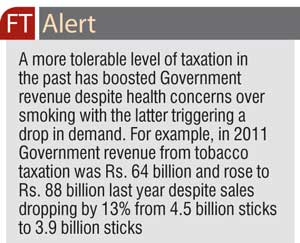
A more tolerable level of taxation in the past has boosted Government revenue despite health concerns over smoking with the latter triggering a drop in demand. For example, in 2011 Government revenue from tobacco taxation was Rs. 64 billion and rose to Rs. 88 billion last year despite sales dropping by 13% from 4.5 billion sticks to 3.9 billion sticks.

Analysts said if the Government had pursued a more pragmatic taxation policy, revenue to the Treasury from tobacco would have increased to Rs. 110 billion next year and to Rs. 146 billion by 2020.

Industry analysts’ forecast of a loss in revenue comes hot on the heels of Finance Minister Ravi Karunanayake last week emphasising that overall Government collection had increased considerably.

In a statement last week, Karunanayake said overall Government revenue for the first nine months of 2016 had increased from Rs. 959 billion to Rs. 1,180 billion. “Income tax revenue in particular increased and public revenue as a percentage of GDP that was only 11% will increase to 13.5% by the end of the year,” the statement said.

Important revenue collecting organisations such as the Excise Department, Inland Revenue Department and Customs were highlighted in the media statement as being responsible for improved performance of public finance, according to Finance Minister Karunanayake.

Analysts said a drastic increase in prices had forced smokers to switch to non-revenue generating alternatives such as Beedi and smuggled cigarettes. Recent detections by Customs on the latter offer evidence of a new lease of life for cigarette smugglers following the Government hike in prices.

The 50% drop in sales has also forced the Ceylon Tobacco Company to review the future operations of four of its leaf depots including in Anuradhapura and Sigiriya. The downturn in sales has also impacted traders and farmers reliant on the tobacco industry. 
www.ft.lk

Sri Lanka's Bank of Ceylon launches 13.5-pct 5-year debt sale

ECONOMYNEXT - Sri Lanka's state-run Bank of Ceylon is offering 5-year publicly traded debt paying 13.25 percent in an 8.0 billion rupee sale fixed and floating rate bonds that opens on December 21.

The bank is offering 5-year bonds (Type A) paying a fixed rate of 13.25 percent annually, and 8 -year bonds paying a fixed rate of 12.75 percent.

It is also offering 5-year floating rate bonds at the 6-month gross Treasury bill rate plus 1.25 percent and 8-year bonds also on the same basis.

Bank of Ceylon in Sri Lanka's largest lender.

Fitch Ratings has issued a 'AA(lka)' rating for the issue.

Sri Lankan shares hit more than 8-mth closing low led by heavyweights

Reuters: Sri Lankan shares closed at their lowest in more than eight months in thin trade on Wednesday ahead of the Christmas weekend, falling for a seventh straight session led by blue chips and large caps, stockbrokers said.

The Colombo stock index ended 0.12 percent weaker at 6,227.34, its lowest close since April 6. The bourse has fallen 1.7 percent in seven straight sessions through Wednesday.

"This is a typical year-end market. We expect the turnover to be lower until the new year," said Prashan Fernando, CEO at Acuity Stockbrokers.

Turnover stood at 426.6 million rupees ($2.86 million), less than this year's daily average of around 743.3 million rupees.

Foreign investors sold a net 97.1 million rupees worth of shares on Wednesday, but the bourse has seen year-to-date net foreign inflow of 600.4 million rupees worth into equities.

Shares in top conglomerate John Keells Holdings fell 0.96 percent, while large cap Ceylon Tobacco Company lost 0.7 percent to drag down the overall index.

($1 = 149.0500 Sri Lankan rupees) 

(Reporting by Shihar Aneez; Editing by Biju Dwarakanath)
Sri Lanka Treasuries yields rise across the board at auction

ECONOMYNEXT – Yields on Sri Lanka Treasury Bills rose across the board at Wednesday’s auction with the 03-month bill up five basis points to 8.65 percent from last week, the debt office said in a statement.

The yield on the 01-year bill rose 03 basis points to 10.14 percent while that on the 06-month bill rose 05 basis points to 9.61 percent at auction, it said.

The debt office, a unit of the central bank, for Rs46 billion worth of bids and accepted bids worth only Rs7.6 billion.