Tuesday, 11 April 2017

Sri Lankan shares gain for 10th straight session as foreign buying continues

Sri Lankan shares rose for the tenth straight session on Tuesday to close at their highest in nearly four months, helped by positive sentiment over continued foreign buying in blue chip stocks.

The market has seen fund inflows for 15 straight sessions through Tuesday, with foreign investors buying net 4.9 billion worth of equities in the same period.

They net bought shares worth 49 million rupees ($323,163) on Tuesday, raising the year-to-date net foreign inflow into equities to 7.39 billion rupees.

The Colombo stock index ended 0.2 percent firmer at 6,305.54, its highest close since Dec. 9. The index rose 3.8 percent last week, posting its second weekly gain in seven.

The index has climbed 5.53 percent in the last ten sessions through Tuesday.

"It was a dull day as most of the investors are on holiday ahead of the new year," said Atchuthan Srirangan, a senior research analyst with First Capital Holdings PLC.

"Foreign investors are active and the market is up."

Sri Lanka will celebrate its traditional new year this week and the markets will be closed on Thursday and Friday.

However, turnover stood at 281.6 million rupees, its lowest since March 21 and well below this year's daily average of 757.3 million rupees.

Shares of conglomerate John Keells Holdings Plc rose 1 percent, while Lanka ORIX leasing Company Plc rose 1.16 percent. 

($1 = 151.7500 Sri Lankan rupees) 

(Reporting by Ranga Sirilal and Shihar Aneez)

Foreign buying boosts Bourse

  • Net foreign buying for past 10 weeks propels pre-Avurudu rally 
  • Both indices up year-to-date for first time; net foreign inflow tops Rs. 7 b
After many months of pessimism, the Colombo stock market has shown signs of positivism spurred by heavy foreign buying boosting overall sentiment.

As of Friday, both price indices were up year-to-date - the All Share Index by 1.04% and the more active S&P SL Index by 2.5% after being negative during most of the first quarter. More importantly, foreign buying has accelerated, thereby swinging interest back into the market and boosting sentiment as confirmed by a near 4% gain in ASI last week and over 5% during the past nine market days.

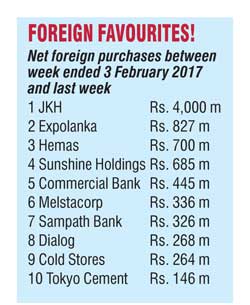
Foreign buying spree which kicked off in late February brought in a net inflow of Rs. 5 billion in March. As of Friday net foreign buying was Rs. 7.35 billion year-to-date. The market has seen net foreign buying for the past ten consecutive weeks and during the past 14 market days the value was Rs. 4.85 billion. The inflows are significant given the fact that for the entirety of 2016 the inflow amounted to only Rs. 400 million whilst in 2015 there was a Rs. 5.4 billion outflow.

Most analysts welcomed the newfound resurgence in the market as “long overdue” given the attractive valuations. However, it is foreigners who are capitalising on the bargains, especially fundamentally sound blue chips and second tier stocks.

Brokers expect locals who have cashed in from foreign interest to return to the buying side, a move, which if it takes place after the Sinhala Tamil New Year holidays, will help sustain the rally. The Price Earnings Ratio of the market is around 12 times with some fundamentally strong stocks much lower reinforcing the attractiveness of equities.

Last month Asia Securities told the Sri Lanka Investment Summit in Hong Kong that when the three largest stocks, which account for 18% of market cap, are excluded the PER is more attractive at nine times.

It also said that valuations at the CSE are close to post-war bottoms while when net foreign buying is positive, the market moves up with a 12-month lag.

Capital markets in general are however hoping for a more convincing return of local investors, who have been shunning the Bourse for seemingly better returns outside. This is despite several leading broking firms’ chosen or recommended portfolio of stocks having provided much better returns than some fixed income options last year.

“Foreigners see value in some select blue chips now. Now we see there is a demand for stocks mainly because foreign investors are buying them gradually,” Acuity Stockbrokers CEO Prashan Fernando was quoted as saying by Reuters last week.

“Foreign buying and foreign interest in blue chips are pushing the market up and we hope the trend will continue,” said First Capital Equities Ltd. senior research analyst Atchuthan Srirangan.

“Though retail investors are still on the sidelines, the good thing is foreigners and high net worth investors are grabbing the opportunity and buying,” Yohan Samarakkody, head of research at SC Securities, was quoted as saying by Reuters earlier in the week.

“The underlying fundamentals have not changed as yet. The economic outlook is gloomy with high interest rates. But all that negativity has factored in. With the market reaching an oversold level, it became attractive to investors who have the holding capacity and they are capitalising on that situation,” Samarakkody added.
www.ft.lk

BPPL Holdings Records Net Profit Of Rs 393 Million

BPPL Holdings announced its interim unaudited financial results for the eleven month period April 2016 to February 2017.

Consolidated revenue for the period was Rs 2.2 billion, up 19% over the corresponding period in the previous year. Revenue continued to grow as the company pursued its dual objectives of penetrating the household market segment both through direct sales to retailers and own branded goods sales in Sri Lanka and Indonesia.Direct sales accounted for 11% of total sales for the period, up 30% year-on-year. Own branded goods also grew by 55%, again over the corresponding period in the previous year.

Gross profit was up by a faster 30% year-on-year to Rs 881 million due to margin expansion amid revenue growth. Gross profit margins, which improved from 37% to 40% during the eleven month period ended February 2017, continued to benefit from higher productivity, lower costs as a result of improved raw material sourcing and Sri Lankan Rupee depreciation against the US Dollar.

Improved productivity and stringent cost controls also led to a 47% increase in operating profit to Rs472 million compared to the same period in the previous year. Moreover, margins continued to expand to 21% at a Profit-Before-Tax level due to lower interest expenses asaccumulated profits were used for debt retirement. Profit-Before-Tax was Rs453 million for the period whilst Profit-After-Tax attributable to the company’s shareholders was Rs393 million, an increase of 48% year-on-year.Non-annualized EPS for the period amounted to Rs1.28 (based on number of shares as at 28th February 2017).

Meanwhile, BPPL Holdings moved ahead with its plans for extruding synthetic yarn by placing orders with machinery suppliers following successful trials conducted with its own hot washed recycled PET flakes and discussions with leading textile producers. The construction of a new factory in the Horana BOI Industrial Zone also commenced in January 2017. This yarn production facility, which involves an investment of Rs 675 million, is set to comeon-stream in the January to March quarter of 2018 and contribute to revenue from April 2018.

The company is also on track to commence power generation from its own 347KW solar and 200KW biomass based power plants later this month.

BPPL offered 30,685,000 ordinary shares priced at Rs12 per share to the public via an Initial Public Offeringrecently, which was fully subscribed on the first day.

Sri Lanka forex reserves drop 10-pct to US$5.1bn in March

ECONOMYNEXT - Sri Lanka's forex reserves dropped 514 million US dollars to 5,119 million US dollars in March from a month earlier, central bank data showed.

Sri Lanka's forex reserves usually drop when the central bank prints to finance the government and defends the exchange rate when the newly minted cash drives up credit and ends up in the forex markets as imports.

Sri Lanka usually ends up printing money to sterilize interventions and maintain a policy rate incompatible with credit demand and inflation or exchange rate target.

Sri Lanka's forex reserves can drop when government loans are repaid with forex reserves, reserve assets falls on revaluation and repayments are made to the International Monetary Fund, for loan taken in 2009.

However it March it is not clear whether there were any IMF repayments.

Sri Lanka missed an IMF reserve collection target for December and a repaid tens of billions of rupees of a maturing bond with printed money in a self-destructive move, in a bout of fiscal dominance of monetary policy.

The central bank scrambled to undo the damage over the next five weeks.

Analysts have warned that the IMF program is lacks domestic asset ceiling which would have prevented the central bank from printing money and also protected it from fiscal dominance.

Sri Lanka poultry firm ups export of parent stock chicks

ECONOMYNEXT - Sri Lanka's Three Acre Farms Ltd, a unit of Singapore controlled Ceylon Grain Elevators group said it had upped exports of parent day old chicks to South Asian countries and were looking to expand the business.

In 2016, rupee export revenues from parent broiler chicks rose 83 percent to 85.6 million rupees.

"The Management team has identified opportunities in regional export markets as potentially lucrative areas capable of generating substantial improvements to the Group’s top and bottom line performance," the firm told shareholders.

"During the year in review, TAF successfully secured new orders for exports of Broiler Parent Stock DOCs to countries in the South Asian region and the Group is actively seeking out further opportunities to expand its presence in regional export markets over the coming years."

"While the company has previously engaged in limited export business, during the course of 2016, TAF was able to secure relatively small but consistent orders which were expanded upon to great effect, and now holds the potential to further enhance revenue streams for the Company in the coming financial year."

Sri Lanka cannot build a business exporting poultry (chicken meat) due to economic nationalism involving trying to build an autarky in Maize with high farmgate prices and restrictions of imports through import duties.

Within Sri Lanka Three Acre Farms claims a 20 percent share in broiler day old chick market and 3 to 38 percent share in layer chick market.

TAFL also has commercial farms producing adult broilers for meat processing.

Sri Lanka in March lifted price controls on chicken.

Sunday, 9 April 2017

Sri Lanka’s biggest bank reports 43% growth in net 2016 profit

Bank of Ceylon (BoC) has reported a record-breaking pre-tax profit of Rs.31.2 billion for the year ending December 31, 2016, while post-tax profit stood at Rs.24.8 billion. The profit for 2016 at Sri Lanka’s biggest bank is a sharp 43 per cent rise from 2015.

Total operating expenses increased by 7 per cent in line with the business expansion. However depicting the BoC’s effective cost benefit management,cost to income ratio came down to 43 per cent from 45 per cent compared to the previous year, the premier bank said in a media release on Monday.

Net operating income for the period reflected an improvement of 16 per cent mainly backed by the increase of 17 per cent in net interest income and 59 per cent increase in other operating income.

Reduction of 26 per cent in total impairment charges through a reversal in provision following improved Non Performing Loans (NPLs) has also complemented the increase in net operating income. In 2016 many policy rates were changed affecting the market interest rate to move upward. In January

2016 Statutory Reserve Ratio (SRR) was increased by 150 bps to 7.5 per cent and Standing Lending Facility Ratio (SLFR) and Standing Deposit Facility Ratio (SDFR) also increased during the year up to 8.5 per cent and 7.0 per cent.

“Whilst, the increasing trend in market interest rates has resulted in an increase in both interest income and expenses, the BoC has managed to maintain its interest margin at the previous year level of 3.3 per cent through its effective management of cost of funding. Interest income earned through investment activities particularly in Sri Lanka Development Bonds and Treasury Bonds also contributed towards the growth in the net interest income,” the release added.

“Despite the decline in net fee and commission income by 8 per cent compared to the previous year in the light of subdued performance experienced across the export industry, 59 per cent impressive growth in other operating income showcased the BoC’s ability of making its targets a reality through various avenues among challenges. This operating income includes Rs.3.1 billion capital gain from disposal of investment too,” it added.

The bank reported Rs.1 trillion in loans and advances base, with total assets reaching Rs.1.7 trillion as of end 2016 .

The deposit base accounted for 80 per cent of the BoC’s liabilities as at end 2016 and grew by 16 percent to Rs.1.3 trillion from end December 2015.
www.sundaytimes.lk

CSE new rules on errant firms of public float in June

By Duruthu Edirimuni Chandrasekera

The Colombo Stock Exchange (CSE) will issue directions on non-compliance pertaining to public float by June, officials said.

The Securities and Exchange Commission (SEC) has now sanctioned the minimum public float rules that represent a portion of shares of a listed firm that are in the hands of public investors as opposed to shares owned by the company’s institutional shareholders and will enforce penalties for those who don’t comply, they said.

Early last year, 30 – 40 listed firms requested more time to comply with these rules. Also certain listed firms which don’t fall into SEC’s minimum public flat requirements announced their intention to get off the CSE. The officials said that the penalties on non-compliant firms will also kick in by June. They declined to say what they were.

The rationale for a minimum float is that a sizeable public float is a necessity to ensure a market is fair, orderly and efficient, a CSE official said. The introduction of a minimum public float as a continuous listing requirement is considered by all regulators in order to promote liquidity and ensure a better price discovery mechanism, he added. “It’s an established fact that greater the public float less is the potential for market ” he said. The time duration for compliance will end in June.

Research by the SEC found that as at June 2011, 35 per cent of the listed firms in the Main Board had a public float below 20 per cent while 12 per cent had a public float below 10 per cent. Data showed that 36 per cent of the Diri Savi Board companies had a percentage below 10 per cent.


Stockbrokers want brokerage increased,CAR relaxed 
Stockbrokers who met with Treasury officials late last month to appraise the Finance Ministry of their plight had urged the authorities to increase their brokerage on trades amongst other issues.
The brokers at this meeting had said that the Colombo Stock Exchange (CSE) is now facing an unfavourable situation due to the continued slump. The main All Share Price Index peaked in August 2014 after breaking past the 7,000 point mark, they had said noting that it has steadily declined since then, due to many uncertainties.
While the brokers are faced with several serious issues especially operational and their cash-flows are strapped, they added that some companies are mulling pay cuts from this month. The SEC’s new rules in capital adequacy which direct the implementation of a risk based Capital Adequacy Requirement (CAR) of 1.2 times the risk requirement of stock brokers subject to a minimum liquid capital requirement of Rs. 35 million was also criticised. 
Treasury officials said that the regulator had pointed out that certain broking firms had ‘minted’ cash during the 2010 – 2012 era, but they had extracted cash from their main broking firm to start ‘unrelated’ businesses. They had said that while it’s their onus to carry out their own business, it was also their responsibility to retain buffers for the core business. Analysts say while this argument is debatable, the onus also falls on the trading firms to cut costs and manage their businesses.
The current rules on minimum Net Capital applicable to stockbroker firms do not address the different risks these firms are exposed to, one Treasury official said adding that the SEC had noted that due the foregoing limitations of the then rules and in keeping with international standards, a dire need to establish stock brokers a risk-based capital adequacy requirement was felt.
Having considered the capitalisation of stockbroker firms, their current activities and CAR regimes implemented in regional markets, the CSE together with the SEC developed the methodology for the rules, the SEC had said.This meeting followed a discussion over the prevailing crisis situation which had been held between the heads of stock broking companies and CSE authorities on March 27.
www.sundaytimes.lk