Saturday, 13 May 2017

Lanka IOC PLC posts Rs. 652 m loss in Q4; blames it on Govt. policy

  • Steep rise in fuel prices in global markets; Lankan prices last revised in January 2015
  • Significant increase in taxes and depreciation of rupee; costs not allowed to be passed on to customers
Lanka IOC has recorded a loss of Rs. 652 million in the fourth quarter compared to a profit of Rs. 1.56 billion a year earlier but managed to achieve improved results for the full financial year of 2016/17.

Profit achieved in FY17 was Rs. 3 billion, up from Rs. 2.2 billion in FY16.

LIOC said the loss in the 4th quarter was mainly on account of losses incurred on sale of petrol and diesel.

“Due to steep increase in prices of petrol and diesel in the international market, coupled with significant increase in taxes and depreciation of rupee, the margins on petrol and diesel have become negative,” the company said in a statement.

The retail selling prices were last revised in January 2015.

Since then, the USD/LKR exchange rate has increased from 131.93 to 151.74 as on 31 March and this huge impact has not been passed in retail selling prices. Similarly, taxes have been increased drastically on both petrol and diesel and these significant higher taxes have not been passed on to customers through higher retail selling prices. For some time, margins on diesel compensated the loss in petrol, but now both the products are making losses.

LIOC said the current quarter of the financial year 2017/18 will be a big challenge for the company since landed cost of petrol and diesel is much higher than the prevailing retail selling prices in the market and more than 75% of its turnover is derived from auto fuel segment.

In spite of continuous losses, LIOC has continued to sell the products from its retail outlets, in fact more than the industry average.

Against industry growth of 9%, LIOC sales growth was 17% during 2016/17 in the auto fuel segment. LIOC also witnessed good increase in volumes in lubes and bitumen segments despite tough competition and entry of new players. LIOC has spent major capex at refurbishment of facilities at retail outlets and maintenance of infrastructure at Trincomalee Tank Farm.

“At present, we are continuously selling our auto fuel products with negative margins. Even though currently having red mark in auto fuel, we could report profit for the financial year 2016/17, mainly due to the positive margins in diesel in the beginning of the year and pleasing performance of our other business segments,” LIOC Managing Director Shyam Bohra said in the statement.

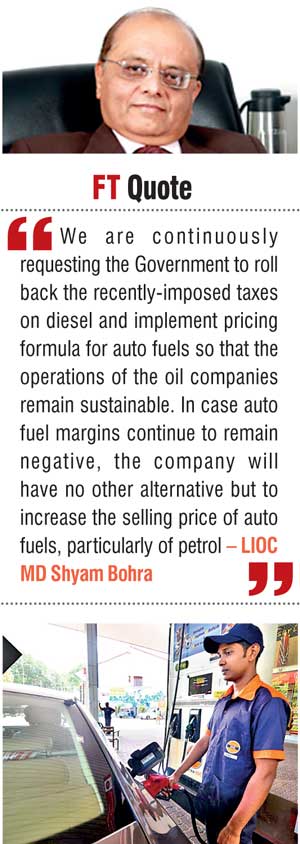
“We are continuously requesting the Government to roll back the recently-imposed taxes on diesel and implement pricing formula for the auto fuels so that the operations of the oil companies remain sustainable. In case auto fuel margins continue to remain negative, the company will have no other alternative but to increase the selling price of auto fuels, particularly of petrol,” Bohra added.
www.ft.lk

Friday, 12 May 2017

Ironwood Investment raises stake in Sri Lanka Abans Finance

ECONOMYNEXT – Ironwood Investment Holdings (Pvt) Ltd, a Colombo-based private investment company, has raised its stake in Sri Lanka's Abans Finance, a licensed non-bank lender, to 31.89% from 20%.

A stock exchange filing said Ironwood Investment Holdings bought just over 10 million ordinary shares or a 15.3% stake in a recent rights issue.

Ironwood had held 11 million shares in Abans Finance, acquired last year in a private placement.

Sri Lanka tea broker invests Rs233mn to get land for warehouse

ECONOMYNEXT – Ceylon Tea Brokers, a Sri Lankan tea brokerage, said it had acquired a subsidiary of another brokerage which has access to land on which it intends building a warehouse.

A stock exchange filing said Ceylon tea Brokers had entered into a share sale agreement with Lanka Commodity Brokers to buy Logicare Pvt Ltd. for Rs233 million.

Logicare owns the lease to a land in Muthurajawela, north of Colombo port, for 39 years.

The area is home to several warehouses of tea brokers which store tea meant for the Colombo auctions and export.

Sri Lankan shares end near one-year high; blue chips lead

Reuters: Sri Lankan shares ended marginally higher on Friday, near a one-year high, led by gains in blue chips such as Ceylon Tobacco Company Plc and conglomerate John Keells Holdings Plc.

Stockbrokers said they expect the bullish trend to continue next week with the central bank holding key policy rates steady amid falling T-bill yields.

With the pressure on the rupee abating and yields on government securities easing, the central bank kept key interest rates steady at a policy meeting on Tuesday.

The Colombo stock index ended 0.08 percent firmer at 6,671.98, its highest close since May 18, 2016. The index added 0.5 percent this week, its seventh straight weekly gain.

"The interest rate decision is a boost to the market. That was kind of a direction to say now the trend in the rising interest rate should reverse," said Hussain Gani, deputy CEO at Softlogic Stockbrokers.

Financial markets were closed on Wednesday and Thursday for Buddhist religious holidays.

Turnover stood at 651.6 million rupees ($4.28 million), less than this year's daily average of 891 million rupees.

Foreign investors net bought shares worth 38.5 million rupees, extending their year-to-date investment in equities to 16.81 billion rupees.

They bought a net 14.32 billion rupees in the last 33 sessions, out of which, foreign investors were net buyers in 32.

Reduction of 36-38 basis points in T-bill yields in the last three weeks, stable currency on expectation of inflows from foreign borrowing, and an IMF statement on the disbursement of the third tranche of a $1.5 billion loan, have helped boost sentiment, analysts said.,,

Shares in Ceylon Tobacco Company Plc rose 0.7 percent, while John Keells Holdings Plc gain 0.5 percent and Commercial Bank of Ceylon Plc, the country's biggest listed lender, climbed 0.9 percent. 

($1 = 152.3000 Sri Lankan rupees) 

(Reporting by Ranga Sirilal and Shihar Aneez; Editing by Vyas Mohan)

Thursday, 11 May 2017

Sri Lanka Monetary Board holds key rates unchanged

(LBO) – Sri Lanka’s Monetary Board held key interest rates unchanged on Tuesday on slower inflation, a month after hiking rates, a monetary policy statement said.

Colombo Consumer Price Index headline inflation decelerated to 6.9 per cent in April from 7.3 per cent in March, year-on-year, a factor which supported the decision, the statement said.

The growth of credit extended to the private sector by commercial banks decelerated to 21 percent by end February and 20.4 percent by end March, year-on-year, although growth of broad money (M2b) remained high at 20 percent in March.

“In the external sector, the cumulative trade deficit increased to US dollars 1.7 billion in the first two months of 2017 from US dollars 1.2 billion in the same period of 2016.”

“This was a reflection of the combined impact of the decline in export earnings and increased expenditure on imports, particularly as a result of the drought conditions.”

The government securities market and the Colombo Stock Exchange saw foreign inflows in recent months, while the government issued its 11th International Sovereign Bond (ISB) worth US dollars 1.5 billion this month, priced favourably at 6.2 per cent.

“These inflows, along with other expected financial inflows to the government and the likely disbursement of the 3rd tranche under the IMF Extended Fund Facility (EFF), would support the balance of payments and the country’s reserve position.”

As at end April 2017, gross official reserves were estimated at US dollars 5.0 billion compared to US dollars 6.0 billion at end 2016.

Given these factors, the Monetary Board decided to maintain the Standing Deposit Facility Rate (SDFR) and the Standing Lending Facility Rate (SLFR) unchanged at 7.25 per cent and 8.75 per cent respectively.

Full policy statement:

As expected, the Colombo Consumer Price Index (CCPI, 2013=100) based headline inflation, decelerated on a year-on-year basis to 6.9 per cent in April 2017 from 7.3 per cent in March 2017, and CCPI based core inflation also decelerated to 6.8 per cent in April 2017 from 7.3 per cent recorded in the previous month. It is expected that inflation based on the National Consumer Price Index (NCPI, 2013=100), which edged up in March 2017, will also display a similar decline in April 2017. Supported by monetary policy adjustments from end 2015, inflation is projected to decelerate gradually to the desired mid-single digit levels by end 2017, although there could be some monthly fluctuations due to short term supply side disruptions and the base effects of tax revisions in 2016.

With the upward adjustment in market interest rates, the year-on-year growth of credit
extended to the private sector by commercial banks decelerated gradually to 21.0 per cent by end February 2017 and 20.4 per cent by end March 2017, from 21.9 per cent recorded at end 2016. However, despite the deceleration observed during the first two months of 2017, the year-on-year growth of broad money (M2b) remained high at 20.0 per cent in March 2017 compared to 18.4 per cent at end 2016 mainly on account of the expansion in credit to both private and public sectors in absolute terms during the month.
This included the expansion of credit to public corporations, some of which were affected by the impact of the drought and increased international energy prices. As market interest rates remain substantially high, both in nominal and real terms, it is expected that credit extended to the private sector will decelerate to the envisaged levels by end 2017.

In the external sector, the cumulative trade deficit increased to US dollars 1.7 billion in the first two months of 2017 from US dollars 1.2 billion in the same period of 2016. This was a reflection of the combined impact of the decline in export earnings and increased expenditure on imports, particularly as a result of the drought conditions. Tourist arrivals and related earnings improved in the first four months of 2017 in spite of the partial closure of the Bandaranaike International Airport during the first quarter, although there was a moderation in inflows from workers’ remittances during the first quarter of the year. Both the government securities market and the Colombo Stock Exchange experienced foreign inflows in recent months, while the government issued its 11th International Sovereign Bond (ISB) worth US dollars 1.5 billion this month, priced
favourably at 6.2 per cent. These inflows, along with other expected financial inflows to the government and the likely disbursement of the 3rd tranche under the IMF Extended Fund Facility (EFF), would support the balance of payments and the country’s reserve position. As at end April 2017, gross official reserves were estimated at US dollars 5.0 billion compared to US dollars 6.0 billion at end 2016, while the Sri Lankan rupee depreciated by 1.5 per cent against the US dollar during the year up to 05 May 2017.

Considering the above, the Monetary Board, at its meeting held on 08 May 2017, was of the view that the current monetary policy stance is appropriate. Accordingly, the Monetary Board decided to maintain the Standing Deposit Facility Rate (SDFR) and the Standing Lending Facility Rate (SLFR) of the Central Bank unchanged at 7.25 per cent and 8.75 per cent, respectively. The Central Bank will closely monitor macroeconomic developments in the period ahead in order to adopt further measures, if required.

Wednesday, 10 May 2017

Sri Lanka's Dialog posts 5% revenue growth in First Quarter, 28% increase in tax remittances

Sri Lanka's premier telecommunications service provider, Dialog Axiata PLC announced its consolidated financial results for the three months ended 31st March 2017. Financial results included those of Dialog Axiata PLC (the 'Company') and of the Dialog Axiata Group (the 'Group').

The Group continued its growth momentum across Mobile, Tele-infrastructure and Fixed Line businesses to record a consolidated Revenue of Rs. 22.2 billion for Q1 2017, demonstrating a growth of 5% Year-on-Year ('YoY').

However, the First Quarter Revenue contracted 3% relative to Q4 2016 as consumer spending was restrained by increased consumption taxes on communication services spanning Mobile, Fixed, Broadband and Pay Television.

Group EBITDA for Q1 2017 grew 3% YoY to reach Rs. 7.2 billion whilst Group EBITDA contracted 3% Quarter on Quarter ('QoQ') on the back of drop in Revenue. The Group EBITDA margin for the Quarter was recorded at 32.6%.

The Group NPAT (Net Profit after Tax) declined 42% YoY, impacted by increase in depreciation, net finance cost and forex losses while NPAT demonstrated a growth of 24% QoQ to be recorded at Rs. 1.5 billion driven by lower non-cash translational forex losses as the Sri Lankan Rupee depreciated against the US Dollar by 1.5% in Q1 2017 compared to 2.2% during Q4 of 2016.

The Dialog Group continued to be a significant contributor to state revenues, remitting a total of Rs. 10.5 billion to the Government of Sri Lanka (GoSL) during Q1 2017 representing an increase of 28% YoY.

Total remittances included direct taxes and levies (Rs. 3.6 billion) as well as consumption taxes collected on behalf of the GoSL (Rs. 6.9 billion).

Further endorsing Dialog's leadership position in Sri Lanka's fiercely competitive ICT sector, Dialog was awarded the Telecom Service Provider of the Year for the sixth successive year and the Internet Service Provider of the Year for the fifth successive year at the SLIM-Nielsen People's Awards 2017 organized by the Sri Lanka Institute of Marketing (SLIM) and AC Nielsen.

Group capital expenditure for Q1 2017 was recorded at Rs. 4.0 billion representing a capex to revenue ratio of 18%. Capital expenditure was directed in the main towards investments in High-Speed Broadband infrastructure aimed at further strengthening the Group's position in Sri Lanka's Broadband sector.

Group Operating Free Cash Flow (OFCF) was recorded at Rs. 1.4 billion for Q1 2017. The Group continued to exhibit a structurally robust balance sheet with the Net Debt to EBITDA ratio being maintained at 1.0x as at end of March 2017.

At an entity level, Dialog Axiata PLC (the 'Company') continued to contribute a major share of Group Revenue (83%) and Group EBITDA (79%). On the back of its Mobile customer base of over 12.2 million subscribers.

Company Revenue grew 2% YoY to reach Rs. 18.3 billion for Q1 2017. Company Revenue contracted 4% QoQ due to restrained consumer spending as alluded to earlier.

Company EBITDA declined 9% YoY to record Rs. 5.7 billion for Q1 2017 on the back of moderate Revenue growth and increased cost arising from expansion of network and IT capabilities. In line with performance dynamics at EBITDA level and forex losses, Company NPAT declined 43% YoY and 12% QoQ to record at Rs. 1.7 billion.

Dialog Television (DTV) continued to consolidate its leadership position in the Digital Pay Television space with the subscriber base surpassing 866,000 as at end March 2017. Revenue declined 5% YoY and 1% QoQ to record at Rs. 1.5 billion for Q1 2017 with subscription Revenue growing 3% YoY, whilst EBITDA was recorded at Rs. 65 million for Q1 2017, increased 108% YoY and contracted 12% QoQ. DTV NPAT recorded a Net Loss of Rs. 311 million for Q1 2017 relative to a Net Loss of Rs. 182 million in the corresponding period of 2016.

Dialog Broadband Networks (DBN) recorded Revenue of Rs. 2.9 billion for Q1 2017, representing an increase of 39% YoY and 14% QoQ. Downstream of strong Revenue performance, DBN EBITDA for Q1 2017 was recorded at Rs. 1.5 billion, representing an increase of 100% YoY and 23% QoQ. On the back of healthy EBITDA performance, DBN NPAT turned positive to record a Net Profit of Rs. 237 million for Q1 2017 relative to a Net Loss of Rs. 119 million in the corresponding period of 2016.

Singer Group revenue increases 13.7% to Rs. 12 billion

Singer (Sri Lanka) PLC announced its results for the first quarter of the year ending March 31st 2017. The results showed a commendable Revenue growth despite sluggish consumer demand resulting from drought affecting the income of about 30% of the agriculture-based households in the country, combined with escalating prices due to devaluation and increase in VAT.
Group Revenue increased 13.7% to Rs. 12 billion. Traditional and thrust product lines of the Company experienced good growth - in smart mobile phones by 56%, televisions by 27%, deep freezers and furniture by 22% each, computers by 18%.

During 1st Quarter of 2017, Singer chose not to pass on the full impact of the increase in VAT and weaker currency to customers. This reduced gross margins to 29.1% compared to 30.6% last year. The increased mix of smart phone sales in 2017, which have lower margins, also impacted the overall group gross margin.

Net finance cost for the 1st Quarter of 2017 increased 45% to Rs 434 million. The lower margins and higher interest both impacted group profitability for the quarter under review. Group net profit for 1st quarter was Rs. 246.6 million, a reduction of 33% compared to the prior year (excluding the one-time gain recorded in the 1st Quarter of 2016). Singer (Sri Lanka) company only, Net Profit in the 1st Quarter increased 49% to Rs. 319.6 million mainly due to dividends from subsidiaries.

Subsidiary Companies, Regnis (Lanka) PLC had a Profit of Rs. 86 million and Singer Industries (Ceylon) PLC had a Profit of Rs. 9.4 million. Revenue of Singer Finance (Lanka) PLC increased by 27% although Net Profit decreased due to higher financing costs, initial cost of credit card operations and impairment of the replaced ERP software programmes.

The company mentioned that its key business initiatives are:

• To accelerate the renovation and expansion of existing shops to increase the retail space to cater for additional products and brands (in particular furniture);

• To strengthen and enlarge manufacturing operations with new factories, additional machinery and more advanced technology;

• To expand the Singer credit card that was launched in 2016. - Singer
www.island.lk