Wednesday, 17 May 2017

Sri Lankan shares extend gains on foreign inflows

Reuters: Sri Lankan shares ended at their highest level in over a year as foreign investors continued to buy blue chips after an annual trade concession worth $300 million from the European Union (EU) added fuel to a rally that started towards the end of March.

Index heavyweight John Keells Holdings Plc ended almost one percent higher on foreign buying. The benchmark index has risen nearly 11 percent since March 31.

The EU on Tuesday said Sri Lanka has regained a lucrative trade concession, mainly for its top exports garments.

The Colombo stock index ended 0.39 percent firmer at 6,718.34, its highest close since Jan. 8, 2016.

Turnover stood at 1.75 billion rupees ($11.48 million), well above this year's daily average of 899.5 million rupees.

"Foreign interest is continuing in blue chips," said Atchuthan Srirangan, a senior research analyst at First Capital Holdings PLC.

Foreign investors net bought shares worth 902.6 million rupees, extending the year-to-date net foreign inflows to 18 billion rupees.

Reduction of 11-38 basis points in T-bill yields in the last four weeks, stable currency on expectation of inflows from foreign borrowing, and an IMF statement on the disbursement of the third tranche of a $1.5 billion loan, have helped boost sentiment, analysts said.,,

Shares in Ceylon Cold Stores Plc rose 4.4 percent while Ceylon Tobacco Company Plc rose 1.4 percent and John Keells Holdings Plc gained 0.9 percent. 

($1 = 152.4000 Sri Lankan rupees) 

(Reporting by Ranga Sirilal and Shihar Aneez; Editing by Vyas Mohan)

Sri Lanka to receive GSP+ concessions from May 19

Rigorous monitoring of Sri Lanka’s conduct on 27 international conventions

By Sanath Nanayakkare

The European Union will remove a significant part of the remaining import duties on Sri Lankan products entering the EU market with effect from May 19 in exchange for the country's commitment to ratify and effectively implement some 27 international conventions it has signed up to.

The Delegation of the European Union to Sri Lanka and the Maldives told the media in Colombo yesterday that as is the case for all countries benefiting from GSP Plus, the removal of customs duties for Sri Lanka would be accompanied by rigorous monitoring on an annual basis of Sri Lanka's commitment to implement 27 international conventions on human rights, labour conditions, protection of the environment and good governance.

"Granting access to the GSP+ scheme does not mean that the situation of the beneficiary country with respect to the 27 international conventions is fully satisfactory. Instead, it offers the incentive of increased trade access in return for further progress towards the full implementation of those conventions, and provides a platform for engagement with beneficiaries on all problematic areas. If we looked for perfect compliance with these international conventions, no country on earth would receive the GSP+ concessions, the EU said.

The granting of EU concessions involves the full removal of duties on 66% of tariff lines, covering a wide array of products, including textiles and fisheries. The removal of duties will come into force a day after publication in the official Journal of the European Union, of the restoration of GSP Plus, which is expected to be on Friday, this week.

Trade Commissioner Cecilia Malmström said, "Granting GSP+ to Sri Lanka aims to provide the opportunity to develop further economically, including creating more and better jobs for all Sri Lankans, on a sound foundation that advances human and labour rights, and in a manner that is environmentally sustainable. It is also a vote of confidence from the European Union that the Sri Lankan government will maintain the progress it has made in implementing the international conventions. At the same time, no one is pretending that the situation is perfect. The process of replacing the Prevention of Terrorism Act still needs to be completed. There are still too many incidents of torture, there are still children being forced into marriage, there are still laws that discriminate against sections of Sri Lankan society. We want to see an end to these practices.

The EU will work closely with the government and Non-Governmental Organisations to rigorously monitor progress."

"If Sri Lanka continues to make necessary progress, then the country has the chance to benefit from the scheme until it achieves Upper Middle Income country status for three consecutive years. On current trends, that should mean that Sri Lanka will benefit from GSP+ until at least 2021. The EU is Sri Lanka's biggest export market, accounting for nearly one-third of Sri Lanka's global exports. In 2016, total bilateral trade amounted to almost €4 billion, and EU imports from Sri Lanka amounted to €2.6 billion. The removal of import duties will provide a total of immediate benefits worth in excess of EUR 300 million a year. The value of the scheme could be worth many times more, particularly if Sri Lanka uses the opportunity to diversify its economy, the EU Delegation in Colombo said.

www.island.lk

Tuesday, 16 May 2017

Sri Lankan shares end at 1-yr high on foreign buying, trade concession

Reuters: Sri Lankan shares hit a one-year closing high on Tuesday with foreign investors buying blue chips such as John Keells Holdings Plc and as the island nation regained a trade concession from the European Union (EU).

The EU on Tuesday said Sri Lanka has regained a lucrative trade concession, mainly for its top exports garments.

The Colombo stock index ended 0.49 percent firmer at 6,692.33, its highest close since May 16, 2016. The index added 0.5 percent last week, its seventh straight weekly gain.

Turnover stood at 1.17 billion rupees ($7.67 million), more than this year's daily average of 889.8 million Sri Lankan rupees ($5.83 million).

"Today the foreigners got active and with that we have seen retail investor's also returning," said Dimantha Mathew, head of research, First Capital Holdings PLC.

Foreign investors net bought shares worth 281.05 million rupees, extending the year-to-date net foreign inflows to 17.08 billion rupees.

Reduction of 36-38 basis points in T-bill yields in the last three weeks, stable currency on expectation of inflows from foreign borrowing, and an IMF statement on the disbursement of the third tranche of a $1.5 billion loan, have helped boost sentiment, analysts said.,,

Shares in Dialog Axiata Plc rose 4.31 percent while Sri Lanka Telecom Plc rose 2.35 percent and John Keells Holdings Plc gained 0.85 percent. 

($1 = 152.6000 Sri Lankan rupees) 

(Reporting by Ranga Sirilal and Shihar Aneez; Editing by Vyas Mohan)
Depressed bourse pushes CSE to propose relaxed rules on public float

By Chandeepa Wettasinghe 

New regulations proposing to grant exemptions for the current minimum public shareholding rules have been proposed due to a stagnant bourse, the Colombo Stock Exchange (CSE) officials said. “When we did the (earlier) regulations, why it was done by the Securities and Exchange Commission (SEC) was because, to get into indices, we needed floats. We needed around four John Keells type of companies. Now the situation has changed. We can’t force people to give up their holdings in a low market,” former CSE Chairman Vajira Kulatilaka said. 

Public floats promote liquidity and lower risks and abuses in a market, which were also among the reasons the SEC cited for bringing in tighter public float regulations. Speaking to Mirror Business just before the end of his term in office, Kulatilaka said the earlier minimum public float regulations were conceived during a bull market. 

“We have to be very careful when forcing somebody. When it’s a growing market, it’s a different story—now the market is down, valuations are too low for them to get out, so we have to respect those decisions,” he said. 

Kulatilaka added that companies are not even willing to offer new shares to raise funds at lower rates. “I for one think if the country was growing at 7 percent and if the companies were growing at 30 percent, they would come here for money. But the problem is that growth has slowed and companies are not growing as much as they would like,” he added. 

Under the new proposals to amend the listing regulations published by the CSE last month, is a proposal for the CSE to be given the power to waive the application of any of the minimum public shareholding rules to any listed entity or any class or category of listed entities under ‘exceptional circumstances’ in consultation with the SEC. 

CSE Chief Operation Officer Renuke Wijayawardhane said over 60 companies are currently not compliant with the public float regulations. 

The SEC relaxed the public float requirements last November, just one month before the end of the grace period for the regulations, which were introduced in 2014, and provided an extra six months for companies to comply with the latest relaxed regulations. 

At least two companies delisted, seven announced their intentions to delist and a score of others downgraded to the secondary board of the CSE in the lead up to the relaxation of the requirements. 

The Carson group, which announced its intentions to delist four overseas oil palm plantation companies worth nearly 2 percent of the CSE’s market capitalization, said it was in discussions with the regulators on actions to take in the future regarding the public float. 

Kulatilaka said the delisting trend raised some red flags for the regulators and facilitators. “There was a delisting trend that was coming, that also we can’t afford to have. We need companies to be listed here, so it was a big dilemma,” he said.
www.dailymirror.lk

Mass resignations from Lanka Hospitals director board

A significant change appears to have taken place in the boardroom of the state-controlled Lanka Hospitals Corporation PLC (LHCL). 

LHCL yesterday disclosed to the Colombo Stock Exchange that all of its local independent non-executive directors, except for two, had resigned with effect from May 9, 2017. 

Public Enterprise Development Ministry Coordinating Secretary Thanuja Weeratne, along with Thiniyawala Palitha Thera, were the only two local directors to not to resign during the Vesak week. A source close to the matter said that the Public Enterprise Development Ministry had sent letters asking for the resignation of the directors. 

The government controls LHCL through a majority share ownership via Sri Lanka Insurance Corporation (SLIC). 

Changes had also taken place at the top level of SLIC as well, with new Co-Managing Director Aruna Siriwardena replacing Keith Damien Bernard. 

The source said that Siriwardena has replaced his predecessor as a Director at LHCL as well, while four of the Directors who stepped down—Asendra Siriwardena, Dr. Anil Abeywickrama, Umashanthiee Rajamantri and Professor Dilani Lokuhetty—have been reappointed to the LHCL board. 

It is not yet clear whether Directors Nandana Munasinghe and Dr. Rohan Wijesundera, who also resigned as per the ministry directive, have been reappointed. The latest changes have not yet been disclosed to the Colombo Stock Exchange.
www.dailymirror.lk

SLT Group reports Rs. 18.7 bn revenue during 1Q, 2017

Sri Lanka Telecom Group during the first quarter 2017 has reported Rs 18.7 billion revenue, a 1.4% year on year growth.

The tax changes made by the government had an adverse impact on the Group’s revenue growth which has also had an impact in its profitability as well. The Group’s operating expenditure increased by 2.7% to Rs. 13.1 billion from Rs 12.7 billion in line with business expansions and external factors.

The impact caused by foreign currency translation losses continued due to the depreciation of the rupee against the USD. During the quarter there was a foreign exchange loss of Rs. 364 million. Owing to the above reasons and increase of depreciation by 19.7% year on year to Rs. 3.9 billion, the profit before tax and profit for the period dipped to Rs. 1.8 billion and Rs. 1.5 billion respectively.

The operating revenue of the holding company increased by 3.6% to Rs. 11.2 billion despite the external challenges as explained above. However, due to the increase of depreciation to Rs. 2.5 billion by 30% year on year and increase of foreign currency translation losses to Rs. 257 million from Rs. 64 million of same period of the last year the profit before tax and profit for the period dipped to Rs. 627 million and Rs. 545 million respectively.

As a pioneer in the ICT industry and as part of a market that shifts very quickly, the SLT assemblage continuously strives to remain technologically innovative.
www.ft.lk

CTC reports 11% slump in tobacco excise revenue in 1Q


Government excise earnings from Ceylon Tobacco Company PLC (CTC) during the first three months of 2017 has dipped 11% compared to the same period last year, to end at Rs. 19.73 billion. Government excise earnings from tobacco in Q1 2016 was Rs. 22.17 billion.

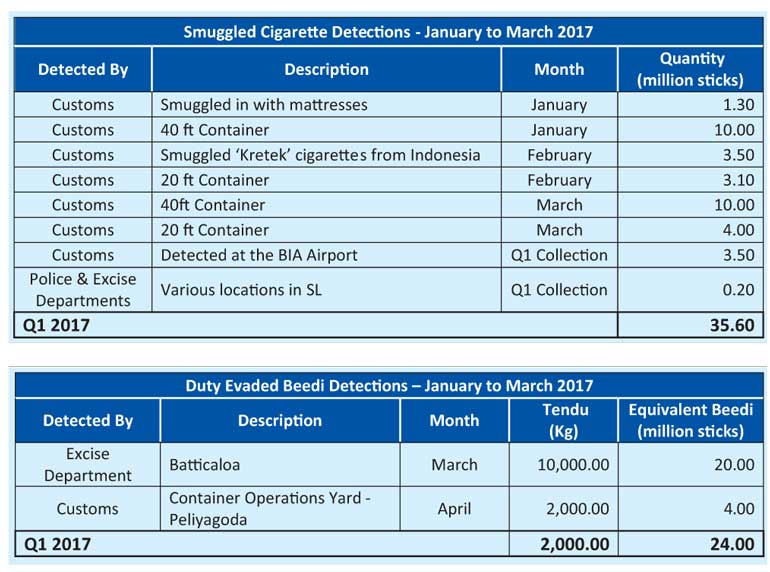
Following the 45% hike in cigarette prices last year, Sri Lanka has turned into a hotspot for illegal tobacco smugglers, with over 35 million sticks valued at Rs. 1.7 billion detected already this year. Over 320 million illicit sticks are estimated to have penetrated the market, resulting in Rs. 13 billion in losses to state revenue.

A further 12,000kgs of smuggled beedi wrappers have also been confiscated by authorities during the first three months of this year, equivalent to 24 million beedi sticks.

Over 216 million beedi sticks are estimated to have been produced during this period, as the high price of legal tobacco products compel consumers to downgrade. The sharp rise of tobacco smuggling and incidence of illicit consumption have defeated the government’s agenda to reduce smoking since the government’s focus has only been placed on excessive taxes on legal products.

During the first quarter of 2017, Ceylon Tobacco Company’s Profit After Tax stood at Rs. 3.19 billion as against Rs. 3.05 billion a year earlier, as the Company put in place several cost rescaling initiatives including the closure of two depots in Anuradhapura and Sigiriya, plus, a 20% head count reduction.
www.ft.lk