Sunday, 29 June 2014

Sri Lanka inflation to be 2.8-pct in June 2014: Treasury Secretary

June 29, 2014 (LBO) - Sri Lanka's inflation would be 2.8 percent in June and the country now had strong economic growth and a stable exchange rate, Treasury Secretary P B Jayasundera said.

Jayasundera told a forum of Sri Lanka's key exporters and importers Friday that as he walked into the forum he got a text message that inflation in June would be 2.8 percent.

"International rates. And last five months plus this month we are having inflation below 5 percent," he said.

"Single digit. So governor central bank can have a carnival. He can be a governor who can claim 'I am a governor of the central bank because monetary policy, financial stability is in place'."

He said no bank has collapsed.

"Exchange rate is flexible, yet foreign exchange rate regime is stable," Jayasundera said.

"Flexibility does not mean ruthless fluctuations. So it needs to be predictable. In fact that has come in line."

He said foreign reserves were also nearly 9 billion US dollars and was moving towards the 10 billion mark.

Sri Lanka's rupee has been facing upward pressure over several months after weak or negative credit growth reduced outflows of foreign exchange as domestic demand fell and a depreciated exchange rate decimated the spending power of the poor and the rich alike.

Sri Lanka is recovering from a balance of payments crisis triggered in 2011 after the state manipulated energy prices with bank loans which were ultimately accommodated with central bank credit (printed money) through sterilized foreign reserve sales.

The rupee fell from 110 to 130 to the US dollar in the wake of the crisis.

Sri Lanka has been prone to high inflation and balance of payments trouble since shortly after 1951 when a hard peg was broken by then finance minister J R Jayewardene and a money printing central bank was set up to join then now collapsed Bretton Woods soft-peg system.

The forex shortages also gave an opportunity for trade-deficit Mercantilists and autarkist- nationalists to raise their head and seek rents from protectionism and import substitution, denying the less affluent affordable access to products especially foods, critics say.


Another pyramid scheme busted

By Charundi PanagodaView(s):

Around September last year, Malin, a businessman from Beliatta, received a phone call from his elder sister who happily informed him about the “really high” returns she was receiving from an “investment” at a company called Panora Advertising. She talked about receiving some Rs. 40, 000 a month from this company.His sister had heard about Panora from a relative of her husband. This relative was recruiting members of his family, and so far had recruited “about a hundred” people for a Rs. 3,000 fee for each person roped in. Even an old aunt of Malin’s had taken out a huge lease on a vehicle to invest in Panora. Around this time, Panora had become “very well known” in the area.

Malin, too, wanted a piece of that pie. So he and a friend drove to Ambalantota, “a little bit further from the town, near the temple,” where Panora’s main office was located “to check it out.” When his sister first told him about the company, frankly, he was suspicious. It all sounded just a bit too good to be true. But when he visited the office, his suspicions began to dissipate little by little.

“The office looked like a legitimate place,” he recalled. “There were about 10 to 15 support staff, computers and the rest. Even some Army personnel were there. I don’t know whether they were buying anything, but they were there.”

Malin and his friend were told that they could receive monthly payment for “watching ads” online. The company’s director, Somalal, explained to them the “business of advertising.” Big marketing companies paid huge sums of money, “about 15 to 20 lakhs,” Somalal told them, to advertise on TV shows. Panora could do for customers like Malin what the big marketers were doing for TV shows, was Somalal’s sales pitch to them.

“He said big ad companies paid them for showing ads,” Malin said recounting the encounter. “He said with that ad revenue, they’d be able to pay about a 25 per cent interest rate on an initial investment from us.”

So Malin purchased a Panora “investment package” for Rs. 156,000 (the minimum package was Rs. 1,800) where he was promised a Rs. 10,000 weekly payment for two years for watching ads online on www.panoraadvertising.net. Malin is only a small-time businessman. He collects “things like pepper” from villages to be sold in Colombo. He got the money to invest in Panora by pawning his wife’s jewellery, thinking he’d recover it all in a couple of months.

Last Monday the Tangalle Police arrested Jayasinghe Manachchige Somalal for defrauding people by running a pyramid scheme. The Central Bank defines a pyramid scheme as “… where a participant is required to contribute or pay money, and the benefits earned by the participant are largely dependent on the increase in the number of participants in the scheme; or increase in the contributions made by the participants in the scheme.”

network marketing, where “individuals sell products to the public — often by word of mouth and direct sales,” according to consumer protection information provided by the Federal Trade Commission, an independent U.S. Government agency. If the money the marketers make is based on actual sales to the public, it could be considered a genuine marketing plan. But if the money is based on the number of people recruited and the number of sales to them, then it’s a pyramid scheme.

According to Central Bank information pamphlets, pyramid schemes can take many guises, such as buying gold coins or “colourful” wrist watches, providing some services online, or as in the case of Panora, asking customers to deposit or invest a sum of money. These schemes were made illegal in Sri Lanka by an amendment to the Banking Act No. 30 of 1988, where offering or participating in a pyramid scheme is deemed a criminal offence.

“Pyramid schemes are ultimately unsustainable because the number of participants increases exponentially,” said Dr. Sirimal Abeyratne, Professor in Economics at the Colombo University. “It can’t run forever, when participants come to withdraw money it collapses, and more the participants greater the damage. A big, island-wide scheme like this could even cripple the whole financial system.”

For his deposit in September last year, Malin received only one week’s payment after a five-week waiting period. After that the payments stopped. Last December, Panora was closed for weeks and its accounts were frozen pending a Central Bank investigation for not being a licensed financial institution, and yet Somalal continued to promise his customers payment. In a YouTube video uploaded about a month ago, Somalal described his legal troubles as “agitation” caused by “jealous people.”

Somalal had been running the scheme for about five months and had recruited about 25,000 customers, said OIC Wasantha Kumara, one of the investigating officers. The company had three bank accounts, and had even issued receipts to customers for transactions, OIC Kumara said. Somalal made around Rs. 150 to Rs. 200 million from the whole venture. He used the money mostly to buy supermarkets and filling stations. By the time he was arrested he had spent over three-fourths of the money he made.

He and a partner of his, Nilan Indika, who has an arrest warrant out for him, had got the idea for floating Panora from an identical establishment in Tissamaharama called Luminous Advertising, which was also busted earlier this year. Somalal and Nilan had worked at Luminous, where they “quickly picked up the business,” OIC Kumara said.

“Somalal was a mason baas by profession,” he added. “He was only educated up to O/L and barely passed even that, but his customers were engineers, doctors, teachers, and even some policemen. However, he is a good orator and really knows how to convince people. He says he did this to earn a living.”

Somalal, a 32-year-old impoverished man from Dikwella, promoted Panora as a legitimate, up-and-coming business with weekly meetings and community events, including one at a Hambantota hotel where about 200 people turned up. The company even got a two-page promotional write-up published in the Sunday Lakbima.

Despite the hype, it eventually came to a point where Somalal could no longer pay his customers. Some angry customers even protested outside his home some months back until the Police dispersed them. Customer complaints mainly prompted police investigations into Luminous and Panora.

Malin is only one out of hundreds of people who lost money in this scheme. A number of victims the Sunday Times spoke with said they had pawned gold jewellery to raise money, jewellery they’ll never get back. Chitra, a small tea shop owner from Tissamaharama said she borrowed money from a number of people last year for a Panora “investment,” when it was gaining popularity in the town. Now she has to ward off the moneylenders, on top of worrying about her children’s school fees.

Central Bank officials say, despite the many public warnings people continue to fall for scams like Panora’s because they are “fooled by the high returns, and get greedy.”"There are so many legal ways to invest but people want to make easy money at whatever risk,” a Central Bank communications official said. “These things are difficult to prevent. It is difficult to convince people of the risk until it’s too late. Despite what happens to others, they think they will somehow get their money back.”

To avoid such potential frauds, officials advise the public to be aware of a country’s normal interest rate and be wary of anyone offering “extraordinary rates.” The Central Bank advises the public only to transact business with financial institutions licensed by the Bank.

www.sundaytimes.lk

Touchwood: A case of deception and confusion

By Sunimalee Dias

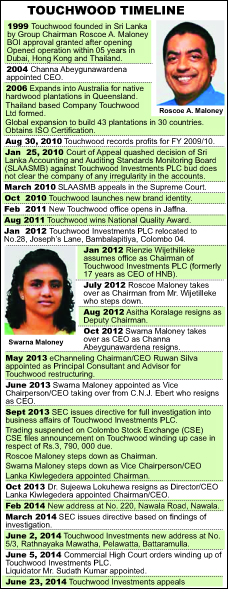
Touchwood Investments PLC has filed an appeal in the Supreme Court against the Commercial High Court order issued to wind up the company.
The company was issued the winding up order on June 5 and liquidator Mr. Sudath Kumar was appointed as well.
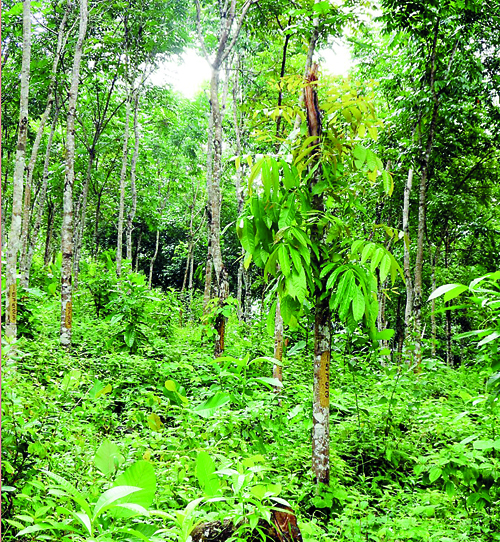
Mahogany trees at the Gomaragala Estate in Eheliyagoda.
However, in a stock exchange filing the company stated that they had appealed their case against the winding up order.
Touchwood Investments PLC ran into trouble when they were found to be unable to pay back their investors cum clients who had invested in the purchase of trees on their teak, mahogany, sandalwood plantations in Sri Lanka and Agarwood plantations in Thailand.
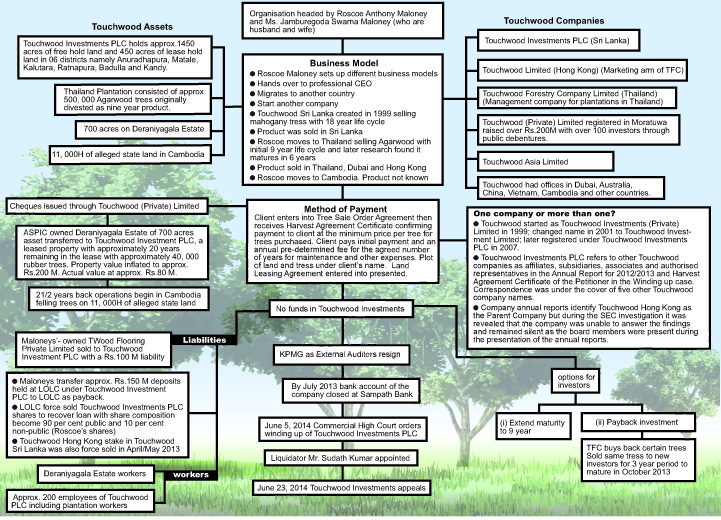
It was found out that in the winding up case that the company had duped investors to believe that all Touchwood companies were connected under one large group.
It was noted during the case that the Touchwood which started as a Touchwood Investments (Pvt) Ltd in 1999 changed name in 2001 to Touchwood Investment Ltd and later registered under Touchwood Investments PLC in 2007.
In fact in their Annual Report for 2012/2013 it was found that the company referred to other Touchwood companies as affiliates, subsidiaries, associates and authorised representatives and even in the Harvest Agreement Certificate of the Petitioner in the winding up case. But correspondence with the investors was carried out under the cover of five other Touchwood company names.
The chart indicates the number of companies that were run by Roscoe A. Maloney along with his wife Swarna Maloney.
During the investigation carried out by the Securities and Exchange Commission (SEC) it was noted that the board of directors present remained mum when queried about the number of companies and their connections except to state that the companies only had common directors namely Roscoe and Swarna Maloney and Asitha Koralage who was the company’s Deputy Chairman.
When the company ran into problems in terms of paying back the investors upon the maturity of the trees it was found that the company management was scurrying from one end to another in another in a bid to get the money.
In this respect, the Maloneys used their Touchwood (Pvt) Ltd company registered in Moratuwa to raise over Rs.200 million through a debenture issue to settle the Agarwood plantation clients.
They were found to have settled their personal due to by inflating the values on assets belonging to Touchwood PLC. This money the Maloneys’ used to purchase controlling interest of ASPIC Holding Private Ltd (which is a holding company of Central Investments Finance PLC).
In addition, following investments made in Cambodia on alleged state land development the Maloneys’ borrowed money through Touchwood Investment PLC for Cambodia property firm Touchwood Investment PLC Property with 5 acres of vanilla and 5 acres of sandalwood in Matale valued around Rs.27 million used to settle lenders.
Moreover, the Maloneys’ transferred approximately Rs.150 million deposits held at LOLC under Touchwood Investment PLC to LOLC as payback.
LOLC sold Touchwood Investments PLC shares to recover loans with share composition become 90 per cent public and 10 per cent non-public (Mr. Maloney’s shares) and the Touchwood Hong Kong stake in Touchwood Sri Lanka was also sold in April/May 2013.Further during the court hearings it was revealed that cheques presented in open court by current Touchwood Investments PLC Chairman Lanka Kiwlegedara to pay back the petitioner in the winding up case had bounced.
At the conclusion of the hearings the Commercial High Court issued the order based on the fact that the company had no money to pay back the investors as a reason for the winding up as a result of which the liquidator was appointed as well.
The fact that the company’s continuous failure to settle the debts owed to the Petitioner and other creditors have also been made note of when delivering the Order.

CIFL: Depositors plan to appeal against recent court ruling

By Quintus PereraView(s):

The CIFL (Central Investment and Finance Ltd) depositors are restlessly awaiting a copy of last week’s Appeal Court decision dismissing their case against the CIFL and the Central Bank (CB) as they want to file an appeal in the Supreme Court (SC).

The dismissal of the appeal paves the way for the CB to go ahead with its restructuring plan unless the depositors are able to move the SC to get a stay order pending determination of their proposed appeal.

Some members of the CIFL Depositors Association (CIFLDA) monitoring the stock market have found one individual, believed to be a politically-powerful government advisor, to be continuously buying CIFL shares in the past few days to the tune of 250,000 shares per day.

In this manner, if this person continues to purchase shares he could be a majority shareholder and later there is a possibility of his coming forward as an investor. One of the CIFLDA members explained that if the person becomes an investor the commitment of the interest thereby paid to the depositor would be low.

The total deposits, he said, is Rs. 3.5 billion and assuming 60 per cent is converted into shares (under the CB plan) the amount so converted is Rs. 2.1 billion with the remainder 40 per cent being Rs. 1.4 billion and this 40 per cent would be the existing deposit base.
At the rate of 5 per cent the interest commitment would then be Rs. 70 million only. So, he said, that any investor who makes a low investment will benefit from these flaws.

Then that means, the CIFLDA member pointed out. the deposit liability could be brought down and the interest commitment would then come down, making it an investor-oriented plan and not a deposit-oriented one. He said that thus, whoever who now purchases large chunks of shares at such low rate as 60 cents per share could be working on an agenda set by the authorities.

Meanwhile M.A. Gunasinghe, Administrative Secretary, CIFL Depositors Association (CIFLDA) said their committee met on Monday and confirmed the plan to appeal against the Appeal Court decision.

One depositor, H R Perera, an attorney-at-law himself from Dehiwela, has filed a private plaint at the Fort Magistrates Court to recover his deposit of Rs 1.5 million and the interest thereof as the maturity period is over.

He said the CIFL has failed to pay the capital plus the interest. He said that at the last date the case could not be heard as the summons could not be served and he obtained a further date.

Mr. Perera told the Business Times that several of the CIFL depositors have complained to the police to recover their money and the police is awaiting the Attorney-General’s decision to proceed with prosecutions.

P. K. Mahindapala, Secretary, CIFLDA said that they are in search of genuine investors to finance the failed CIFL and once such investors are found they would be routed through courts. To resolve all these matters they would be summoning a general meeting of all the depositors very soon.

The Business Times is inundated with pathetic woes of these desperate persons, most of them ailing old people, and with their means of living lost, their end appears to be etched in their faces.
www.sundaytimes.lk

Saturday, 28 June 2014

Bad weather drives Maskeliya to the red, but investment sustained

Plants rubber in Bandarawela, citrus and cinnamon on tea estates


article_image
Dr. Sena Yaddehige, Chairman

Maskeliya Plantations PLC, a member of the Richard Pieris group, has posted a loss of Rs.92.2 million in the year ended March 31, 2014 against a profit of Rs.151.7 million a year earlier but had boosted capital expenditure to Rs.230.3 million from Rs.211.4 million the previous year.

The company’s Chairman, Dr. Sena Yaddehige attributed these results to unfavourable weather including excessive rainfall and continued gloomy conditions from May to July with some of their estates recording only 40% of the estimated crop during this period.

Also the wage hike and short supply of key inorganic fertilizer during the financial year had hurt the company with the situation worsening with dry weather in the last quarter of the year under review.

Production was down 8% during the year to 8.25 million kg. of tea and despite better prices, turnover was down 4% to Rs.3.4 billion.

The crop was the lowest ever due to adverse weather conditions in the Maskeliya, Upcot and Talawakelle regions. However, they have maintained good quality in the tea produced.

Capital expenditure covered replanting and maintenance of tea (Rs.164 million), Rs.39 million for rubber planting, Rs.14 million for fruit cultivation and Rs.2 million for cultivating cinnamon.

Maskeliya had planted rubber in poor tea land and cultivable bare land in the Bandarawela region and expected that dendro power (gliricidia) and fruit cultivation projects undertaken will give long-term benefits upon completion of the crop diversification process.

"Maskeliya Plantations PLC commenced harvesting of timber in accordance with the Forestry Management Plan during the year under review. Action has already been initiated to

plant timber species in the areas where timber has been harvested in order to establish the same canopy in the plantation and to generate income in the future," Yaddehige said.

"The company plans to introduce more effective methods to improve productivity and to eliminate losses due to the shortage of workers during high cropping periods."

Maskeliya controls 10,561.33 ha of land in Upcot, Maskeliya, Talawakelle and Bandarawela.

The company has a stated capital of Rs.673.7 million, a general reserve of Rs.540 million, timber reserves of Rs.517.4 million and retained losses of Rs.321.8 million in its books. Total assets stood at Rs.4.2 billion and total liabilities at Rs.2.79 billion.

RPC Management Services (Pvt) Ltd with 83.40% is the major shareholder followed by David Pieris Motor Company (2.15%) and Mr. C.P. de Silva (1.45%).

A management fee of Rs.150.4 million, down from Rs.184.1 million a year earlier, had been paid to the parent company, the report revealed.

The directors of the company are: Dr. Sena Yaddehige (Chairman), Mr. J.H.P. Ratnayeke (Deputy Chairman), Mr. S.S. Poholiydde (CEO), Dr. H.S.D. Soysa, Mr. E.M.M. Boyagoda and Dr. L.S.K. Hettiarachchi (w.e.f. 02.05.2014)
www.island.lk

Three production lines in new Biyagama factory operational

DPL profitable despite Rathupaswela disaster


article_image
A.M. Pandithage, Chairman

Dipped Products PLC, one of the world’s leading manufacturers and distributors of protective gloves, has completed what its Chairman called "the most challenging period the company ever endured" as a result of the forced closure of its Rathupaswala factory.

DPL Chairman A.M. Pandithage, has told shareholders in the company’s recently released annual report, that their hand was forced despite independent investigations confirming that the factory’s treated effluents were not the cause of alleged ground water quality issue.

Despite the factory closure costing the company tidily, DPL saw group revenue down only by a marginal 2% to Rs.23.1 million although the group’s after-tax profit was down 35% to Rs.1.16 billion and the profit attributable to equity holders of the parent down 44% to Rs.795.1 million.

Focusing on overcoming multitude of challenges that followed the closure of the factory, DPL took a strategic decision to incorporate a new glove manufacturing facility at the BOI’s Biyagama industrial zone.

"The closure of the factory unfortunately led to severe losses across the value chain, from rubber farmers to our global customers, apart from the loss of foreign exchange to the country," Pandithage and DPL’s Managing Director K.I.M. Ranasoma said in a joint statement in the annual report.

The contribution by the group’s hand protection sector to the bottom line was down to Rs.910 million during the year under review from Rs.1.34 billion a year earlier.

Profits from plantations too were down to Rs.747 million from Rs.962 million a year earlier, the statement said. This was as a result of the depressed rubber market, adverse weather conditions and a 20% wage increase effective during the year under review.

"Profit before tax decreased by 32% at Kelani Valley Plantations PLC compared to the previous year, while Talawakelle Tea Estates PLC recorded its second highest earnings since inception," the statement said.

Mabroc Teas, a branded tea exporter, had delivered improved results during the year with revenue up 7% to Rs.2.47 billion and the pre-tax profit up to Rs.49 million.

Pandithage and Ranasoma said that the new factory at Biyagama involved a total investment of Rs.1 billion and this fast tracked project had seen three manufacturing plants already into commercial production.

"This strategic investment decision also supports adding new capacity to cater to DPL’s future growth," they said.

DPL expressed its gratitude for the understanding and cooperation extended by their customers worldwide during a difficult period and thanked them for the trust placed on the company. Their endurance in continuing with DPL despite the tremendous pressures within their own business operations, arising from supply disruptions for more than 10 consecutive months, was highly appreciated.

The new Biyagama factory owned by DPL Premier Glove Manufacturing Limited, approved by the BOI, was expected to reach steady production by the third quarter of the current financial year.


"In the medium term, DPL Premier Gloves factory will add new production capacity for unsupported latex gloves with a view to expanding DPL’s market footprint in this segment. Likewise, we will gear up to expand our supported glove output in order to improve our product portfolio to cater to the industrial sector hand protection needs," the report said.

DPL accounts for approximately 5% of global production of non-medical rubber gloves. A predominantly Sri Lankan owned company it has many overseas shareholders, a production facility manufacturing medical examination gloves among others in Thailand and a marketing company based in Italy.

DPL has a stated capital of Rs.598.6 million, capital reserves of Rs.457.3 million and revenue reserves of Rs.6.3 billion in its books. Total assets ran at Rs.20 billion and total liabilities at Rs.10.4 billion.

Hayleys with 41.61% followed by the EPF with 13.06% and Volanka (Pvt) Ltd (a Hayleys company) with 8.14% are the other major shareholders. Haycarb, a subsidiary of Hayleys owns 6.8%.

Earnings per share during the year under review were down to Rs.13.28 from Rs.25.53 the previous year with net assets per share growing to Rs.122.40 from Rs.114.34 a year earlier.

The directors have proposed a final dividend of Rs.3 per share for the year under review on top of an interim Rs.2.50 per share paid in March.

The directors of the company are: Messrs. A.M. Pandithage (Chairman), Dr. K.I.M. Ranasoma (MD), R.K. Witanachchi (Deputy MD w.e.f. 01.01.2014), N.Y. Fernando (Retired 12.12.2013), R. Seevaratnam (Resigned 30.07.2013), F. Maiden, K.A. Fernando, L.G.S. Gunawardena (Resigned 28.02.2014), S.C. Ganegoda, Dhammika Perera, M. Bottino, R.M.T. Premarathna (Resigned 20.11.2013),V.R. Gunasekara, S. Rajapakse (w.e.f. 30.07.2013), G.K. Seneviratne (Retired 08.04.2013) and Ms. D.S.N. Weerasooriya (Alternate to Dhammika Perera - appointed on 01.12.2013).
www.island.lk

Equity One Chairman sees "exciting prospects’’ ahead

Sale of six acres in Mt. Lavinia enables capital gain and debt release

Mr. D.C.R. Gunawardena, the Chairman of Equity One PLC, a listed real estate and property developer, sees "exciting prospects and opportunities" flowing into their business from economic fundamentals that are in place assisting the real estate segment of the economy.

Equity One has closed the financial year ended March 31, 2014 on what the Chairman called a "high note" with overall occupancy at group level rising to 91% from 85% a year earlier.

"However the key highlight for the year was the addition of further 44,000 square feet to the group’s rentable property portfolio with the completion of renovation and refurbishment of the building held by subsidiary company, Equity Two PLC, at assessment No.55, Janadhipathi Mawatha," he said.

"We also succeeded in sourcing a tenant to occupy the entire floor area of the said building, immediately upon completion."

As a result they expect this property to generate what he called "a decent contribution" to the group’s rental income and future earnings although the impact on incremental cash flows will be limited.

This is because the company has received rent advances and deposits against payments due on occupation by the tenants and such funds have already been deployed to finance the project.

The sale of six acres of land in Mount Lavinia during the year under review had helped Equity One to substantially reduce debt by way of repayment.

The decision to sell this land was strategic to reduce borrowings that arose mainly from the cost incurred to pay this land.

"From the losses incurred by the group from property development activities, we have now consolidated to a greater extent with the settlement of a significant portion of the company’s debt," Gunawardena said.

During the year under review Equity One saw the profit after-tax up 48.47% to Rs.127.2 million. However, if the one-off gain on the sale of land and appreciation in fair value of investment property is discounted, the net profit was Rs.47.4 million against the previous year’s Rs.42.1 million.

The one-off gain on the land sale amounted to Rs.79.8 million while the fair value gain on revaluation of investment properties amounted to Rs.68.8 million.

"With the burden of debt affecting the balance sheet eased to a greater extent during the year, your company is well positioned to reap maximum benefits from the real estate sector growth envisaged and reach new heights in time to come," Gunawardena said.

He also reported that the issue of restricted access to Janadhipathi Mawatha remains unresolved up to now. This has an adverse impact on the value potential of their two properties located there.

"However, considering the develop 

ment projects taking place in the Fort area coupled with the admirable level of beautification and township development activities underway in the vicinity, we are optimistic that our properties will be able to realize their full potential in the near future," he said.

Equity One is a member of the Carsons group with a stated capital of Rs.1.09 billion, capital reserves of Rs.13.2 million and revenue reserves of Rs.771.5 million. Total assets ran at Rs.2.44 billion and total liabilities at Rs.497.1 million.

Carson Cumberbatch with 96.27% is the dominant shareholder with all other shareholders owning less than one percent.

Net assets per share had grown to Rs.46.38 from Rs.41.93 the previous year and the share traded at a high of Rs.35.70 and a low of Rs.25.40 during the year under review. This compared with trading range of Rs.41.20 to Rs.22 the previous year.

The sale of the Mount Lavinia land for Rs.571.2 million yielded a net gain of Rs.79.8 million. The renovation of the Janadhipathi property owned by Equity Two PLC, a subsidiary of Equity One, cost Rs.199.6 million and added 44,000 sq. ft. to the group’s total rentable area.

The directors of the company are: Messrs. D.C.R. Gunawardena (Chairman), S. Nagendra, K.C.N. Fernando, E.H. Wijenaike, A.P. Weeratunge, S. Mahendrarajah and P.D.D. Fernando.
www.island.lk