Monday, 13 June 2016

Higher margins for Sri Lanka’s Royal Ceramics larger tiles

ECONOMYNEXT – Sri Lanka’s Royal Ceramics group aims to expand production of larger format tiles, which has helped it make higher profit margins as demand grows with a construction boom amid high import tariff protection.

Managing Director Nimal Perera said the group had made investments in the modifications, enhancements, and ongoing development of squaring and glazing lines and polishing lines and expansion project.

The upgrades had been done in Royal Ceramics, and its subsidiaries Royal Porcelain and Rocell Bathware plants.

“Our decision to introduce large format tiles to the local market . . . have already proved to deliver higher margins, thereby growing both topline and bottomline, making for an impressive balance sheet,” he told shareholders in the company’s annual report.

The ceramic tile and sanitary ware industries have been positively impacted by global oil prices falling sharply since the last quarter of 2014, helping the company and the industry to bring down production costs.

Perera said Royal Porcelain aims to commence manufacturing of the largest floor tile of the size 600mm x 1200mm once its new press is operational.

High tariffs on imported ceramic tiles and sanitary ware help provide protection to the local industry, analysts said.

Quality focus cuts tea losses at Sri Lanka Watawala Plantations

ECONOMYNEXT – Sri Lanka’s Watawala Plantations said a shift to focusing on quality helped it reduces losses from tea despite lower production volumes amid the prolonged slump in commodity prices.

Profits from the group’s pal oil business helped cushion losses from tea and rubber, Managing Director Vish Govindasamy said.

“Having focused on maximising yields for a number of years, we commenced a programme for changing the strategic direction last year to a focus on quality in response to the market developments,” he has told shareholders in the firm’s annual report.

Advance pruning to manage rush crop and leaf quality together with selective purchases of bought leaf enabled Watawala to improve the quality of inputs with all estates getting Rainforest Alliance certification confirming adherence to international standards on social and environmental aspects.

Consequently, Watawala Plantations General Sales Average ranking at the auctions improved from 19th position in 2015 to 5th position in 2016 reflecting the improvements in quality.

This meant the average price per kilogram of Watawala teas increased Rs13 a kilo despite the average market price declining by Rs27, Govindasamy said.

The quantity sold by the firm declined 9 percent to 9,412,650 kg increasing the efficiency of working capital turnover.

“Overall, the paradigm shift from quantity to quality resulted in the tea sector losses reducing by Rs197 million in 2016 to Rs230 million compared to Rs428 million in 2015,” Govindasamy said.

“We were able to maintain profitability in Palm Oil business despite declining prices as the extent bearing fruit increased during the year and negotiating forward contracts for supply of palm oil which facilitated greater stability in pricing.”

Profits from palm oil were Rs685 million which cushioned the losses from tea and rubber despite a decline of 12 percent over the previous year.

What will 2016 bring for Sri Lanka’s real estate market?

Since the civil war ended seven years ago, Sri Lanka has rapidly become a hotspot for investment among emerging markets. It has become especially popular with those looking to invest in property.

Chinese investors are particularly interested in investing in Sri Lanka, as demonstrated by China’s recent involvement in developing the upcoming Colombo Port City. Recent political moves such as the “Restrictions on Alienation of Land Bill” in 2014 are encouraging foreign direct investment (FDI).

Furthermore, the construction of new buildings is on the rise, as is the demand for luxury property both in the capital, Colombo, and elsewhere.

Overview of Sri Lanka’s Economy

According to the World Bank, Sri Lanka grew at an average rate of 6.4% between 2010 and 2015. It is set to continue to grow at a reasonable pace. As the country becomes more and more urbanised, it is becoming wealthier. In 2015, the service sector was the country’s most important sector, followed by manufacturing, and agriculture.

The World Bank indicates that the poverty rate is improving and that the country is pushing to become a “higher middle-income country” very soon. However, according to the Asian Development Bank, foreign exchange reserves are not going in the right direction in the country, and GDP growth in the 2015-2016 period is not as fast as it was back in 2011-2012. The government will have to make some changes to make sure that rapid growth picks up again. Nevertheless, in terms of the general state of the economy, GDP growth is still reasonable (4.8% per year in 2015 according to the Asian Development Bank).

What is the property market looking like in Sri Lanka?

In recent years, the island’s property market has been booming, with a greater and greater demand for luxury properties. Colombo’s skyline has transformed as an increasing number of luxury construction projects are completed. According to a Sales Manager working in luxury development in Colombo, “I don’t think that market saturation for this specific product will come soon”.

This is party due to the fact that many native Sri Lankans who have been living abroad are looking to return now that the country is doing so much better than before. This is excellent news for the property market. Although some people say that the supply is greater than the demand when it comes to property in Sri Lanka, if you compare cities like Colombo with others (e.g. Singapore), you can see that this is not the case.

Are property prices increasing in Sri Lanka?

According to KPMG, a super luxury condo would cost you an average of 308 USD per square foot, a luxury condo would cost you an average of 93 USD per square foot, and a semi-luxury condo would cost you an average of 39 USD per square foot. House prices in many provinces are increasing, especially the Northern Province (a 23.47% increase was reported in the Global Property Guide for Sri Lanka).

Other provinces where house prices are on the rise include Central Province Sabaragamuwa Province, Western Province, Southern Province and North West Province. Although there is a lot of emphasis on luxury property in real estate journals, more affordable property is coming onto the market as Sri Lanka becomes more of a middle-income country.

What is the outlook for 2016 in terms of purchasing property?

Back in 2015, Sri Lanka’s government announced a budget to boost foreign investments. The removal of the land lease tax was huge in this regard. A news report from news.lk says that while laws previously banned foreigners from owning property and penalised non-nationals who rent with higher taxes, the new government is more encouraging.

This move will make investing in Sri Lanka’s real estate sector much more appealing to investors and as a result, the demand for property in smaller cities will grow. Properties are not only sought after in Colombo; Kandy is now becoming much more popular. In addition, the range of property prices is diversifying, with the country gradually becoming more accessible to middle-income families, especially when it comes to purchasing land or property in less well-known towns or cities.

Another factor that will help the real estate sector later in 2016 is MP Karunanayake’s decision to reduce levies on accommodation in the travel industry. This will assist landlords in the country who are providing tourists with short term lets and could encourage buy-to-let investors. The economy will also grow as a whole thanks to a stronger tourism industry.

Infrastructural development and laws encouraging FDI will be the main contributing factors to a strong second half of 2016. According to the Financial Times, “The country also has a long way to go before property prices catch up with other international holiday destinations”.

However, in comparison with other emerging markets, the real estate sector in Sri Lanka is very successful and new construction projects are always on the cards.
www.dailynews.lk

Listed firms 1Q earnings gain 16% to Rs. 61 b

Untitled-1Earnings of listed companies witnessed a sharp growth of 16% in the first quarter of 2016 to Rs. 61 billion as against a 5% improvement in the fourth quarter of last year.

Capital Alliance Research attributed the “strong growth” due to weaker economic conditions during 1Q2015. Trailing twelve month (TTM) market earnings grew 3.3% year on year (YoY) to Rs.209.2 billion supported by low interest rates and improving disposable incomes driving consumption, compared to 17.1% during the same period last year due to improved economic conditions starting 4Q 2014.

CAL analysed 269 companies which reported earnings in the quarter ended 31 March 2016 and 272 companies reporting earnings for quarter ended on 31 December 2015.

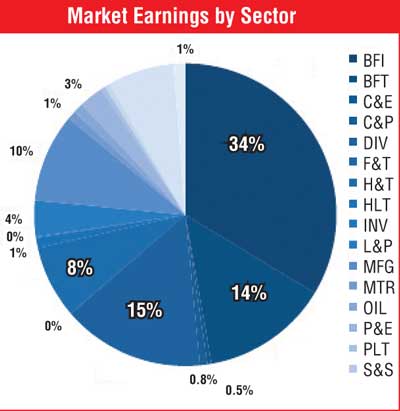
CAL Research, the research unit of Capital Alliance Ltd., said Banks, Finance and Insurance (34%), Diversified Holdings (15%) and Beverage, Food and Tobacco (14%) were the largest sector-wise contributors to market earnings in 1Q2016.

Power and Energy (+344% YoY), Footwear & Textiles (+158% YoY), and Investment Trusts (+127% YoY) had the largest growth during 1Q2016, while Motors (-56% YoY), Trading (-48% YoY) and Construction and Engineering (-59% YoY) suffered the most.

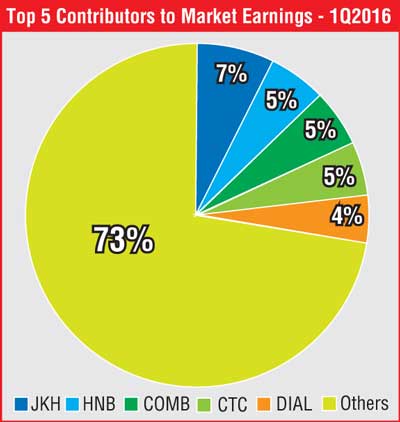
The largest individual contributors to 1Q2016 earnings were John Keells Holdings (7.4%), Hatton National Bank (5.4%), Commercial Bank (5.3%), Ceylon Tobacco (5.0%) and Dialog (4.4%). TFC reported a net loss of Rs. 1.4 billion vs. a net loss of Rs. 366 million in 1Q2015 due to large impairment charges. Excluding TFC, overall market earnings grew 17.7% YoY.

The largest individual contributors to TTM 1Q2016 earnings were John Keells Holdings (6.7%), Commercial Bank (6.0%), Hatton National Bank (5.7%), Ceylon Tobacco (5.4%) and Lanka Orix Leasing Company (4.1%), while the largest growth came from Amana Bank (TTM net profit of Rs. 174 million in 1Q2016 vs. a net loss of Rs. 8 million in 1Q2015).

CAL said the CSE currently trades on a TTM PER of 12.5x as against 11.7 x as at 02.03.2016. The PBV was 1.4x.


www.ft.lk

Saturday, 11 June 2016

Strict forex regulations to go


article_image
Ranil

COLOMBO, (AFP) -Sri Lanka has announced plans to lift six-decade-old restrictions on foreign exchange flows and allow free transfer of money in and out of the island to encourage investment in the struggling economy.

The island tightly controls foreign currency transactions under a 1953 law that does not allow the free repatriation of capital, in an effort to protect its modest foreign reserves.

Under the present strict rules, exporters must bring back their foreign earnings within a short period of time or face penalties. Analysts say the policy deters investors.

"We can remove exchange controls before the next budget (in November)," Prime Minister Ranil Wickremesinghe said in parliament. "We are strong enough to do that. We have that confidence."

Last week, Sri Lanka received the first tranche of a $1.5 billion bailout from the International Monetary Fund (IMF) to shore up the island’s economy, left reeling after a spending spree by the new government.

The premier said Sri Lanka’s foreign reserves were expected to double to $12 billion by the end of this year thanks to loans and grants from China, India and Japan.

The island also plans to raise about $4.2 billion with two bond issues, Wickremesinghe said.

The announcements came during a parliamentary session in which the opposition moved a no-trust resolution against Finance Minister Ravi Karunanayake accusing him of arbitrarily raising taxes.

Earlier this month, Karunanayake sharply raised taxes on cars shortly after announcing an increase in the island’s value added tax from 11 to 15 percent.

But the no-confidence move was defeated by 94 votes in the 225-member assembly, where the ruling party commands a two-thirds majority.

Soon after President Maithripala Sirisena’s government came to power in January last year, the finance minister led a spending spree to implement election pledges of higher public sector salaries and reduced taxes.

However, the country soon found itself in a balance of payments crisis.

The IMF noted last week that Sri Lanka’s economy was under strain from an increasingly difficult external environment and has warned Colombo that it should increase tax collection.

Sri Lanka enjoyed blistering economic growth rates averaging more than 8.0 percent for two years after a prolonged civil war ended in 2009.

But the pace of expansion has since slowed, falling to 4.8 percent in 2015, down from 4.9 percent in the previous year, according to official data.
www.island.lk

Anilana admits Rs. 17 mn. loan, says no winding-up notice received

Mr. Asanga Seneviratne, Managing Director of Anilana Hotels and Properties PLC, has in a letter to the Colombo Stock Exchange on Friday has said the company has not been served with any papers with regard to a winding up application purportedly filed by Millenium Housing Developers PLC in the High Court on June 9.

Seneviratne said in his letter responding to a request for disclosure by the CSE that Anilana had taken a loan for a sum of Rs. 17 million from Millenium which is outstanding. They were presently in discussion with Millenium with regard to the settlement on the loan.

He waid they have not been "at this point" served with any notice with regard to a winding up application.
www.island.lk

Diesel leak cost Coke Rs. 137 million

2015 worst year in a decade, accumulated losses topping Rs. 1.9 billion


The diesel leak from the plant of the Coca-Cola bottler here into the Kelani river had cost approximately Rs. 137 million in claims and expenses relating to the accident that had contributed to a loss of Rs. 640.9 million, up from Rs. 240.4 million a year earlier, of Coca Cola Beverages Sri Lanka Ltd., in the year ended Dec. 31, 2015.

The company’s chairman, Mr. Asoka Wickremesinghe, has said it had to face "an unprecedented and unfortunate situation" from the accidental diesel leakage from the plant in premises adjoining the river.

"However, in expending this amount (Rs. 137 million) your company worked closely with all the authorities and ensured compliance to all the recommendations of all the relevant authorities and demonstrated continued commitment towards environmental management," he has told shareholders.

Excluding the impact of that cost, the company had posted an operating profit of approx. Rs. 50 million against the previous year’s operating loss of approx. Rs. 35 million.

Over and above the diesel leak expense, the company had decided last year to discontinue an under-utilized production line that was operating sub-optimally and use that space for a new sparkling PET (plastic bottles) line.

"Subsequently, your company impaired and scrapped the sparkling and juice RGB line. The financial impact of this decision was approx. Rs. 349 million," Wickremasinghe said.

The end result was the loss which drove the company’s accumulated losses to Rs. 1.93 billion with a loss per share of Rs. 8.47, up from a loss per share of Rs. 1.41 the previous year, with net assets per share down to Rs. 4.55 from Rs. 4.88 the previous year.

Coca Cola continued to lead the country’s sparkling soft drink market gaining 0.3% market share during the year under review. Industry volume too had grown by 14.3% the report revealed.

Coca Cola Beverages is the business preparing, packaging, distributing and selling carbonated and non-carbonated soft drinks, fruit based drinks and fruit juices under various trade marks – Coca-Cola, Coke light, Fanta, Sprite, Minute Maid range of fruit juices and Schweppes owned by the Coca-Cola Company, Atlanta, USA.

The parent undertaking of the Sri Lanka operation is Coca-Cola Sabco (Asia) Ltd. incorporated in the UAE with ultimate control with the U.S. entity.

Despite the 2015 performance being the worst in a decade with losses posted for the last four consecutive years, the parent company had invested approx. Rs. 1.74 billion in the business during the year under review by way of a preference share issue paving the way for repayment of bank borrowings and funding new capital investment.

"Consequently, we laid an important foundation for the future by investing in a new production line," Wickremesinghe said. "Accordingly, your company is looking forward to strategic investments in the business for growing opportunities in the years ahead."

Coca Cola Beverages had total assets of Rs. 6.64 billion in its books on Dec. 31, 2015, with liabilities running at Rs. 2.35 billion.

The directors of the company are Messrs. Asoka Wickremesinghe, Sohli Captain, D.K. Welmillage (resigned Dec. 1, 2015), Mrs. Shukla Watson, J.S. Kuppuswamy, S. Ray, K. Thirumalai and H.K. Bhutani.
www.island.lk